
By Charlotte Bonner-Evans, InFrame Project Manager, University of Glasgow
This blog post is part of the Research Professional Staff Network’s 2026 Conference.
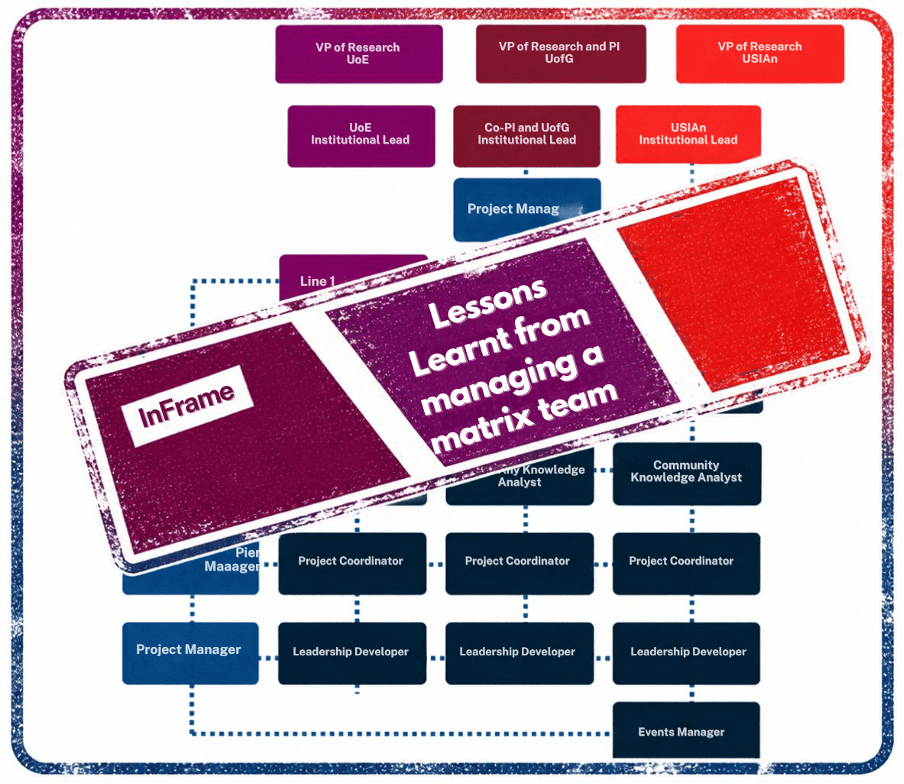
Over the last few years, I’ve had the privilege of project managing the InFrame team, the Wellcome Trust funded project. The team are a group of highly skilled colleagues working across three institutions, multiple reporting lines and different organisational priorities. InFrame was created to explore research culture and collegiality across the three institutions, specifically taking an interest in contextual nuances and applicability of local initiatives in differing spaces. With a team working on one overarching project spanning three institutions, matrix management was applied to ensure operational and functional needs were met.
We often talk about the technical challenges of matrix management, what I’ve learned is that success depends far less on the structure itself and far more on the culture you build within it (Herries and Guccione, 2024). In this post, I will share key lessons learnt from managing a matrix team.
What is matrix management?
A matrix team is a structure where team members report both to a ‘functional’ (local or specialist manager) and an ‘operational’ manager – often a project manager, like me (Team Asana, 2026). Complex projects require expertise from different areas and in the case of InFrame, different universities. Matrix management is increasingly common within the research ecology, with the widely adopted approach of ‘team science’ (Workman, 2014), and within the university of Glasgow’s’ Research Strategy, collaboration being a key priority for ‘those who conduct research and those who facilitate it’ (University of Glasgow, 2026).
Lesson 1: A matrix structure does not automatically create collaboration
Collaboration does not emerge simply because people are assigned to the same project. In a matrix where the team that is required to deliver work packages by working within their own institution, the priorities of their functional manager, and strategic priorities of their institutional leaders, can compete with the project’s operational needs. In InFrame, the first four stages of the Tuckman ladder model of team development (forming, storming, norming, performing; Tuckman, 1965) cycled multiple times, as the team grew, work package priorities changed, and environments challenged each of us. It is important to recognise that you can go up and down the ladder of team development (Drumm, 2026), and this was prevalent in a team like InFrame, which was formed to push boundaries and make change.
The team was supported to move through these stages with attention, facilitation and care to deliberate actions that supported community building, to move from a disparate group, to a community of colleagues with a sense of belonging (Gourlay, 2024).
Lesson 2: Shared purpose creates alignment
Understanding the vison of ‘why’ the team is together is essential. Embedding and reinforcing the rationale for strategic goals, and a shared sense of purpose is essential to achieving team alignment. From a position of project management, this means returning to the aims and objectives of the project repeatedly, embedding these in processes, and prioritising team and individual development, particularly as the day-to-day focus of the team is determined by the ‘how’ of delivery.
I learned that one of my most important roles was not simply coordinating activity, it was creating space for colleagues to reconnect with the purpose of the work and understand how their contributions fitted into the bigger picture, continually reconnecting the team to the purpose of the project. Below are some practical approaches in which we did this:
- Revisiting project aims regularly (monthly meetings)
- Embedding objectives into planning (e.g. in working group Terms of Reference)
- Connecting individual work, and approaches to project outcomes (individual values were reflected on in team meetings)
- Prioritising development alongside delivery (both team and individual development)
Lesson 3: Trust and communication require deliberate attention
Leading with trust and autonomy rather than control is a deliberate leadership choice that benefited the team. Managing a team of managers and specialist professionals meant that though I held tight grip to the project objectives, I intentionally trusted others to deliver in their preferred way, providing guidance and giving autonomy. An absence of trust is considered the biggest reason for dysfunction in a team (Lencioni, 2024), and building a strong foundation of trust, that allows us to be able to make mistakes (Waters, 2026) and learn together, is paramount when working on a project. Of course, trust can be lost, and when it is, it is important to return to assuming the best intentions of colleagues and actively working to rebuild that trust.
Building trust is not easy when we have differing needs and communication styles. Discussing our communication preferences openly, increased empathy, and reduced misunderstandings. The more we understood one another as people, the easier it became to work together as professionals. I will note here that does not mean that disagreements didn’t occur – they absolutely did! However, what we did strive toward was disagreeing safely, and with reflective action. Practical approaches that were taken to enable celebration of differences and similarities were:
- Team away-day discussions
- ‘Manual of Me’ activities (Manual of Me, 2026)
- Consistent one-to-ones, and individualised management
- Human focussed check-ins, putting people before tasks in meetings
- Engaging with Belbin Team Role analysis (Belbin, 2026)
Lesson 4: Shared leadership builds ownership
An example of strong building of ownership evolved from working together on our sense of shared purpose – the team together redesigned our fortnightly Operations Meetings. Initially, these meetings were manager led, and focussed on giving a status update. The meetings soon became disengaging for all, and the team proposed rotating chairing responsibilities, along with an ‘ice-breaker’ for each meeting. Participation and engagement increased significantly. The solution I was looking for was not in improving the meeting but redistributing the ownership.
This lesson demonstrated how matrix teams benefit when leadership is shared rather than concentrated (Stefanatos, 2026).
Lesson 5: Values matter most when they are co-created
Understanding the core values of your team as individuals means that you can support them in their needs and requirements for navigating their role (Royle, 2026). By co-creating the team values as an intentional activity, we built a shared understanding of what we value in our ways of working, communication, and collaboration. By creating the team values together, we formed collective ownership of the values to take forward into our everyday ways of working. To ensure our values remained active and purposeful, we:
- Embedded values in meetings, in reporting processes and in work package and working group terms of reference.
- Used them to guide expectations of one another, and behaviours.
- Returned to review the values as the team evolved.
Matrix structures bring opportunities and challenges. Diverse expertise, knowledge and adaptability are certainly strengths to be celebrated. Challenges will always arise from a disparate team, uneven management responsibilities, and differences in institutional cultures. Success depends on more than reporting lines and structure. Shared purpose, trust, communication and explicit acknowledgement of values require intentional effort and continual attention. The good news – through the above interventions, the team (according to reflective feedback collected) experienced InFrame as genuinely ‘values led’. Culture and the success of a team is built through everyday practices of individuals (Bonner-Evans et al. 2025), and to the lesser part, systems.

