

By Dr Elaine Gourlay, Research Culture Specialist for Communities and Collegiality
This blog post is part of an ongoing series exploring themes and practices relevant to our aspiring, developing and established Research Leaders.
Lessons from Thesis Mentoring
On its 10th round, Thesis Mentoring has seen 637 PGRs supported through the thesis writing process by postdoctoral mentors (drawn from our UofG research staff and research professional staff communities), helping them to build motivation and healthy habits for writing.
The Thesis Mentoring programme provides a complementary source of support alongside supervision. Within the programme, we make the distinction between the role of the thesis mentor and the role of the supervisor clear. While supervisors guide the intellectual direction of the project and assess the quality of the work, thesis mentors provide PGRs with a dedicated space for reflection, accountability, project management of their writing and self-advocacy. Through regular conversations, mentors help PGRs identify barriers, recognise progress, and develop strategies that work for them.
As part of the training, we encourage mentors to adopt a coaching style of conversation as a primary mode of support for their mentee. We also support the exchange of stories and advice, noting that this is only one method of support, which can build rapport between mentor and mentee but that it can also alienate the mentee if the advice doesn’t feel quite right for them. Not only does embracing a coaching style of conversation enable thesis mentors to remain impartial, but it also supports mentees to find their own ways forward, developing confidence and greater self-awareness.
What if we encouraged PGR supervisors to adopt similar conversational strategies to those which we train our thesis mentors to use?
Why a coaching-style leadership is beneficial for thesis writers
A coaching leadership style focuses on guiding rather than directing. Instead of simply telling students what to do, a coaching leader asks insightful questions, encourages self-reflection, and helps individuals discover their own solutions. It’s about unlocking potential rather than imposing authority. But why is this a particularly effective approach to support your thesis writers?
For many PGRs, the doctorate forms a ‘route to independence’, either as a researcher or in their future career. Therefore, encouraging PGRs to think for themselves and define their own best route forward is in their interests and part of the doctoral training that can set them up for the future.
Often researchers describe the transition to writing as a process of finding or developing their own voice, and by extension, their ‘research identity.’ For this reason, supporting them to take ownership of the research project when writing the thesis can be considered part of the preparation for the viva as it demonstrates the development of their own opinions, thought processes and critiques of the work of others in the field as well as their own research to date.
Of course, supervision is not the same as coaching. Supervisors bring disciplinary expertise, experience of the doctoral journey, support good research practice and have a responsibility to ensure that the research meets the standards required for examination. Doctoral researchers rightly expect advice and guidance, particularly when facing technical, methodological, or disciplinary challenges. The value of a coaching approach is therefore not that it replaces advice, but that it encourages supervisors to resist offering solutions as a first response. By first helping researchers think through a challenge and explore their own options, advice can be introduced where it adds most value, supporting both progress and independence.
Coaching-style questions to try
Coaching-style supervision is not about never giving advice. Rather, it’s about resisting the urge to provide the answer too quickly. When a PGR is stuck, a useful sequence can be:
- Understand the challenge
- Explore what they’ve already tried
- Help them generate and evaluate options
- Offer advice only where needed
- Agree a specific next step
This approach mirrors what many thesis mentors do successfully: helping PGRs develop the confidence and independence needed to navigate the writing process themselves.
Since coaching recognises the whole person and takes a humanistic approach, the conversations themselves will be unique between each supervisor and PGR. However, having a bank of questions to draw on can support supervisors to maintain distance and prevent them from inadvertently advising where a fledgling PGR could find their own way forward. Below, I offer a suggested list of coaching-style questions that supervisors, or indeed thesis mentors, may wish to pick and choose from. This list has been adapted and expanded from Using a coaching approach in PhD supervision, which contains additional questions you may wish to use.
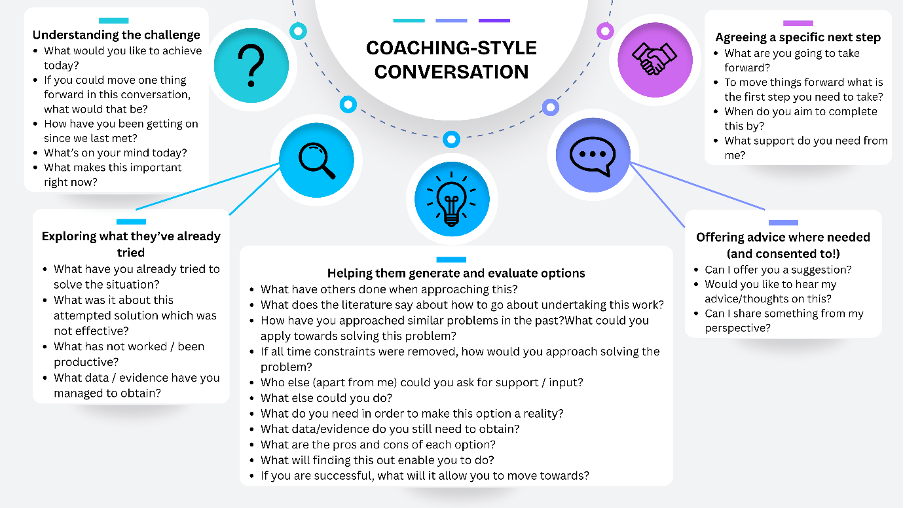
The lasting impact: coach them to the future
The amount and type of support that a doctoral researcher needs varies by individual (for example, in the case of Odyssey PGRs) and will inevitably change across the course of the PhD. Early in the journey, supervisors may need to be more directive, helping researchers navigate unfamiliar processes, disciplinary expectations, and project challenges. As PGRs gain confidence, experience, and expertise, however, the balance can gradually shift. Rather than leading from the front, supervisors can increasingly lead from behind, creating space for researchers to exercise their own judgement, make decisions, and develop as independent researchers.
A coaching style of conversation offers one way to support this transition. By asking thoughtful questions, encouraging reflection, and resisting the temptation to solve every problem immediately, supervisors demonstrate trust in a PGR’s ability to find a way forward. This does not remove the need for advice and guidance, instead it ensures that expertise is offered in ways that strengthen, rather than replace, the PGR’s own capacity for problem-solving.
This is reflected in what we see through Thesis Mentoring. Time and again, PGRs identify practical ways to overcome writing barriers when given the opportunity to reflect, explore options, and develop their own plans. Importantly, these benefits extend beyond solving only the challenge at hand as we observe that having successfully navigated one difficulty, PGRs report greater confidence in their ability to tackle future challenges for themselves.
Ultimately, a doctorate is not only about producing a thesis; it is about becoming an independent researcher. Coaching-style conversations can help PGR supervisors support both aims simultaneously, enabling researchers to make progress in the present while building the confidence, judgement, and self-belief they will draw upon long after submission.

