
By Dr Fraser Rowan, Knowledge Exchange & Innovation Manager, College of Arts & Humanities
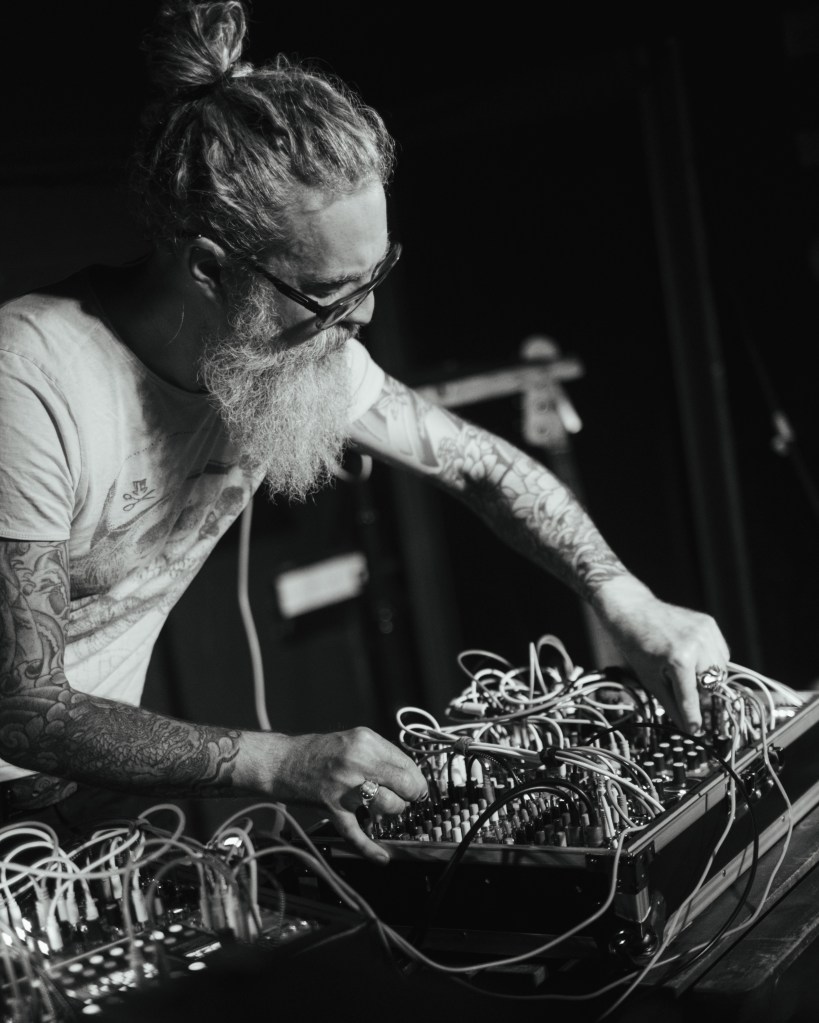
Outside my university role, I write, release and perform original music. I have done so for over three decades. It has never been my profession, but it has been a constant creative practice in my life. There is currently a fierce debate in the music industry about AI-generated music. Should it be allowed? Is it theft? Is it dilution? Is it innovation?
I find myself oddly calm about the whole thing. I would never use AI to compose a piece of music. The emotional arc of creating a new piece of music – is the very thing that makes me tick. It is a craft and for me it is the point of making music. I have however used AI to help name tracks and albums. Articulating in words what instrumental music ‘means’ does not bring me the same joy. It is necessary, but peripheral to why I create. AI can help me without touching the core of what I see as important.
The distinction between craft and peripheral labour is, perhaps also, at the heart of the AI debate in universities. For research professionals working at the interface between academic research, funding systems and external partners, this distinction matters enormously.
The professional craft of knowledge mobilisation
For many academics, writing is not administrative output. It is composition. It is identity. To suggest that AI might draft sections of a paper or proposal feels like asking a composer to outsource their melody. Resistance to the use of AI is about more than following policy or managing risks, such as inaccuracy, hallucination or incomprehensibility, it is about professional meaning. The same is true for research professionals.
In the work of research development, policy, impact, REF preparation, and demand-managed funding processes, there are parts that are deeply crafted: interpreting funder intent, sensing disciplinary nuance, building trust with academics, reading the room in panel discussions, shaping a narrative that feels authentic rather than formulaic.
Mine lies in knowledge mobilisation, facilitating the journey of research beyond the university. This work with academics becomes a kind of detective process, asking “so what?” and “why is that interesting to you?” to surface an intrinsic motivation that resonates with communities of interest. When the lightbulb moment arrives for that colleague (and me for that matter) the craft in my role is most visible.
The professional work of orchestration
Alongside craft, sits orchestration: drafting, summarising meetings, clustering feedback, aligning spreadsheets, formatting documents so that ideas travel coherently. These are necessary tasks. They are time-consuming and one might argue ‘they are not the melody’. AI does not experience these distinctions. It will generate text wherever invited. The critical question, is orchestration work separate from our central craft as research professionals?
Used appropriately, AI can be exceptionally helpful at orchestration. It shortens the distance between a lightbulb moment and a structured articulation of that moment. It compresses iteration time, reducing cognitive fatigue that comes from wrestling with format rather than substance.
In my own work developing cross-disciplinary initiatives at Glasgow, AI has been a genuine amplifier. It did not create the vision, design the processes or hold relationships together. But it accelerated iteration, helped surface connections across qualitative material, and reduced the friction between conversation and articulation. Entire strands of work would not have reached maturity at the speed they did without that support.
Making space for creative system-level thinking
If incorporating AI as a tool can reduce 20–30% of time Research Professionals spend on orchestration what might this mean for institutions making strategic decisions. One response, particularly in our current, financially constrained environment, is predictable: reduce headcount, centralise drafting, standardise processes, and treat AI as a trimming tool. I get that, but it is short-sighted, because orchestration is rarely the core of the value that Research Professionals bring to the university. It is only the labour that surrounds our expertise.
The strategic question is therefore not, “How much can we cut?” It is, “What is possible if we reinvested the time that AI frees up?”. For me, having creative latitude within my role led to the establishment of Catalyst. This, in turn, seeded partnership with Glasgow School of Art, introduced design-led innovation learning, embedded futures thinking methodologies, and culminated in a new flagship experimental programme that required the university to take institutional risk on approaches it had not previously used. If similar space were protected across Research Professional communities, what might emerge? What new income models might be incubated? What cross-disciplinary constellations might be activated? What proactive funding strategies might be designed? What partnerships might be seeded rather than reactively pursued?
Universities often describe themselves as creative institutions because of their research and teaching communities. We rarely extend the same framing to the university’s professional community. Yet Research Professionals sit at the intersection of disciplines, policy signals, partnership ecosystems and institutional strategy. That vantage point is generative – if given oxygen.
The risk of AI is not that it replaces us, instead, the risk is that institutions mistake freed capacity for cost savings rather than opportunity.
Learning by doing?
There is also a developmental question. Manual tasks or task done by hand have traditionally formed part of the apprenticeship of Research Professional work. Drafting early versions of calls, aligning spreadsheets, and summarising feedback, for example, all build tacit understanding of funding landscapes, institutional processes and human behaviour within them. If AI absorbs those tasks entirely, how do we ensure that critical judgement still develops? How do we prevent the erosion of the interpretive skill that distinguishes strong Research Professionals from competent administrators? Again, the issue is not the tool but the design of the system around it.
Used thoughtlessly, AI could produce polished but hollow outputs: impact narratives disconnected from researcher motivation, bids that read coherently but lack authentic transferability, demand-managed processes supported by surface-level pattern recognition rather than deep contextual understanding. However, used responsibly (applying diligence, robustness and rigour) AI could allow Research Professionals to lean further into their craft. Which of these futures unfolds will depend less on the technology itself than on the institutional choices we make about how to use it.
If we treat AI as a way to automate or amplify output, we will shrink the creative surface area of the research professional community at precisely the moment when strategic agility is most needed. Taking the longer-term view, if we treat AI as a cognitive amplifier and reinvest the time it frees, we may unlock one of the university’s most under-recognised assets.
Statement on the use of generative AI: AI tools were used during the drafting and refinement of this article as part of the author’s normal writing and sense-making process.

