Kay Guccione, Head of Research Culture and Researcher Development and InFrame Project Lead. With credit for the collaborative delivery and analysis of this project to the whole InFrame Team, in particular Dr Charmaine Lim, Dr Cristina Vazquez Martin, Dr Joulie Axelithioti, and Zain Ul Abidin.
The title of this post is a direct quote from the 2026 People Make Research project. Since launch in 2022, People Make Research has been an annual highlight in the calendar, describing a project that is designed to surface, celebrate and characterise lived expressions of collegiality in the Glasgow research ecosystem. The project invites any colleague who contributes to Glasgow’s research successes to nominate any other individual or team who they feel enacts collegiality through leadership of their teams, projects, or professional practice. Collegiality has been one of our five research culture priorities at Glasgow since 2019 due to the fact that considerate and intentional relationship maintenance is the basis for research success, effective collaboration, innovative interdisciplinary working, talent retention, and research impact (and more). Because of this we give serious thought to how to build, scaffold and reward collegiality.
People Make Research aims to surface examples of collegial leadership through short colleague nomination statements. Each member of the community can nominate one, or multiple others in any direction across the hierarchy. Since 2022 more than 1000 nominations have been submitted to this process. Nomination texts highlight diverse positive contributions, from the crafting of smooth-running processes, to transformational career mentoring, to community building.
Framing collegial leadership
As well as supporting the visibility and celebration of collegiality in diverse forms, the data from this project has helped us to identify themes that are prevalent in contemporary collegial behaviour. The large volume of data from People Make Research has been analysed as part of the Wellcome Trust funded project – InFrame – which seeks to understand how collegiality can be positioned at the heart of research leadership. The rich examples we have collected through People Make Research (and equivalent projects at our partner universities Edinburgh and St Andrews) have been through thematic analysis, and findings indicate that colleagues across the research community most frequently recognised instances of care, inclusion, drive for excellence, advocacy, mentoring, role modelling, network building, technical contribution, and the purposeful creation of supportive environments. The identified themes are now being built into InFrame’s primary output, a framework for developing collegial research leadership, launching to the sector in Autum 2026.
Show me more!
The padlet boards linked below contain illustrative examples of what our colleagues do that makes such a positive difference and cultivates an environment that upholds the highest standards of fair and inclusive research practice. Our three 2026 categories mirror the three priorities of our University of Glasgow Research Strategy: Collaboration, Creativity and Careers and this shows how positive and collegial leadership delivers research excellence, underpinned by the quality of the staff experience. As Glasgow’s research strategy states “The way we do research is as important as what research is done”. While the two parts of that sentence are often held in tension, the data shows that it’s not about balancing investing research success with investing in a great culture, but that a great culture is what sets more of us up for greater success.
Meet the Glasgow colleagues recognized for facilitating collaboration
For example:
“Her unwavering encouragement and advice were pivotal for me when applying for fellowships, and I could not have felt more supported in this stage of my career. She fosters confidence and builds connections, always guiding with empathy and respect and with a genuine passion for her work.”
“[he] is one of those colleagues who just makes work easier. He brings respect, kindness, and a steady “don’t worry I’ve-got-you” attitude to every interaction. He shares knowledge openly and has genuine enthusiasm for helping others learn. He always respects everyone’s time and somehow makes asking questions to feel completely normal. Adaptable and open to feedback, he lifts morale without even trying. He is inclusive, collaborative, and endlessly supportive, [he] is the teammate who makes the whole workplace feel brighter.”
Meet the Glasgow colleagues recognized for their creativity
For example:
“[…] She built the infrastructure, the methodology and the collaborations needed to turn a clinical service into a genuine research environment. She has enabled honours, masters and international student projects, opened new analytical approaches […] and established a platform for future innovation. What stands out is how she brings others with her. Her work has been transformative across the division.”
“[He] applies his creativity and generous nature to not only supporting digital humanities projects but sharing his knowledge, applying his skills to improve the research environment. He has readily stepped into voids with his technical skill when the College has needed it.”
Meet the Glasgow colleagues recognized for supporting career development
For example:
“[He] may not have been in the School long, but he has already had a significant positive impact on our research culture. He leads in a way that is collegial, transparent, and consistently fair, modelling openness in decision-making and a genuine willingness to listen. He is actively working to bring the School together, fostering collaboration across areas that might otherwise remain disconnected. On a personal level, he has been generous with his support of my research, celebrating successes, offering thoughtful strategic advice, and encouraging next steps. His approach creates an environment where colleagues feel valued, supported, and motivated to thrive.”
“[They have] been pivotal in promoting a culture of safety and responsibility within our research group. Their active role in leading and supporting the Research Health & Safety Committee and ensuring adherence to best practices has set high standards for all.”
Collegiality is contagious
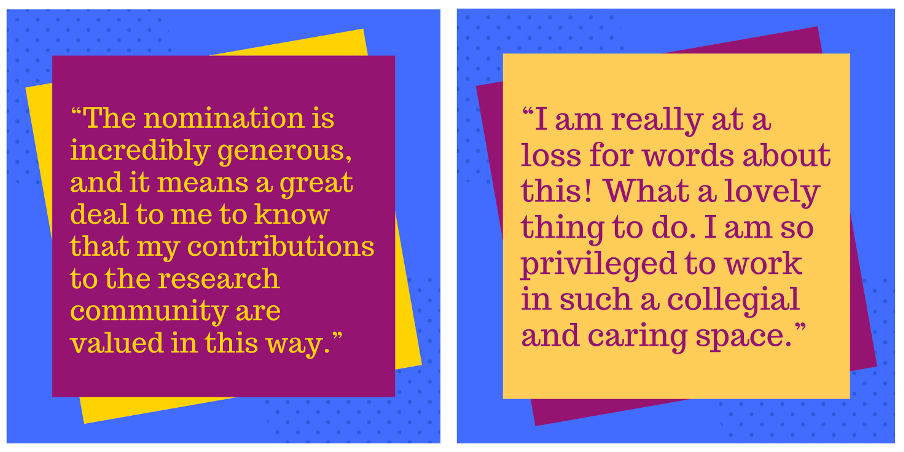
The reaction to being recognised and thanked as part of People Make Research is always heart-warmingly positive, and creates reciprocal celebration, further acts of collegiality, and the momentum to nominate others in the next cycle. As the recipients put it: