
By Lucy McLaughlin, Research Culture and Researcher Development (Communities) Intern
You may or may not have heard of the maxim – in either case, I think it’s fair to say that Nietzsche was on to something when he said, “never trust a negative thought that occurs to you indoors.” In research environments where pressure, pace, and isolation can accumulate, stepping outside is often the quickest way to regain perspective. Walk / Talk / Connect exists to make that shift easier and more accessible for our research communities.
What, when and where?
Walk / Talk / Connect is a monthly lunchtime walking group that encourages PGRs, research and research professional staff to step away from work and connect with nature. Hosted by the Research Culture & Researcher Development Team at the University of Glasgow, each one‑hour walk offers space for both conversation and/or quiet reflection, all while exploring the green spaces around our campus. Some sessions are simple restorative walks, while others introduce light themes or prompts, such as local history, photography, or meditative activities.
The lunchtime walk offers a small but powerful recalibration of mind and mood, and the science behind it is increasingly clear. Studies such as Thøgersen-Ntoumani et al. (2015) show that midday walking improves enthusiasm, relaxation, and nervousness, with benefits most pronounced on active walking days. Walking after lunch also helps counter the familiar afternoon slump, which is why our walks begin at 1pm. Natural environments support cognitive restoration and reduce stress (Bloom et al. (2017), helping members of the research community return to their work with clearer thinking – a small but meaningful shift in a sector where mental load is high and time outdoors can be scarce. Similarly, walking amongst trees can elevate mood as they emit phytoncides which promote serotonin production. Green light is also easier on our vision, giving our eyes some well-earned down time from work and personal screens (The Tree People (2025)). Though our walking route can vary month-to-month, we are mindful to hold space on all our walks for connecting with nature.

Why?
The purpose behind the initiative is twofold: firstly, Walk / Talk / Connect endeavours to support a positive working culture for our research communities by offering an opportunity to step away from labs and screens and reset using the powers of the outdoors. It also aims to promote a greater sense of connection and belonging amongst our research ecosystem; a setting where weak ties can form. This is distinct from other community initiatives like Coffee Connect as the walks bring together PGRs, research staff, and research professional staff – colleagues who engage with research in different ways, from producing it to enabling and supporting its application. This creates a non-academic community space where people can experience the university’s research environment as a diverse, interdependent web rather than a series of parallel peer groups.
This sense of connection we aim to foster is, notably, layered. Firstly, there is a connection with nature as discussed above which has studied, tangible benefits. In a recent analysis, Swami et al. (2026) found that across continents, nature contact promoted greater self-compassion – perhaps a key benefit for those of us working with and through imposter syndrome. Beyond connecting with nature, Walk / Talk / Connect encourages our research communities to connect with themselves and/or the group around them. Each walk offers space for quiet reflection or gentle social interaction, recognising that individuals may need different forms of connection at different times. Some walkers use the hour to go inward, think, and decompress; others come to meet colleagues and feel community. Both approaches are welcomed and both support the initiative’s purpose.
How?
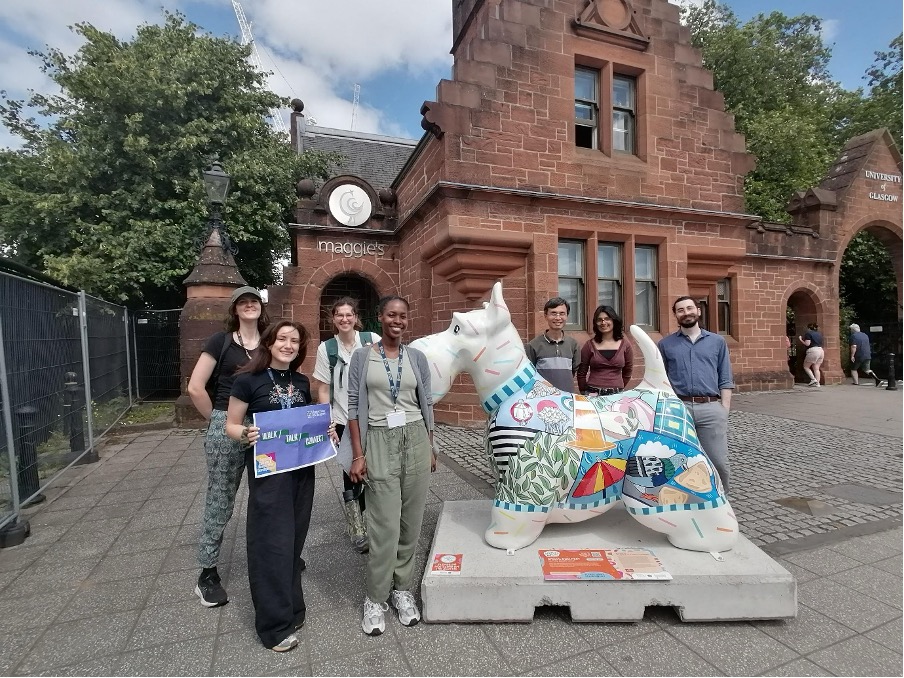
The mechanics behind the walk are intentionally simple. Each walk has two co-leads from the Research Culture and Researcher Development team, and participants can book online in advance. If the walks have a specific theme, they may need to follow a certain route. For example, our recent ‘Scottie Dog Bagging Walk’ led us round five of the Scottie Dog statues which were dotted through Glasgow by Maggie’s, a national cancer charity. This route was planned and practiced in advance, our non-themed walks can be a bit looser. Some people appreciate the novelty of themed walks more than others, which is why we aim to have a balanced mix throughout the year.
In the end, Nietzsche’s warning about negative thoughts indoors reminds us that perspective often shifts the moment we step outside. Walk / Talk / Connect is built on that simple truth: that movement, nature and connection can interrupt the pressures of the working day and return us to ourselves with greater lucidity. By offering a simple, shared practice of walking and talking, Walk / Talk / Connect strengthens the connective fabric of our research communities and opens space for more perspective. A short jaunt may not solve every challenge, but it reliably opens the door to better thinking, and sometimes that’s all we need.

