
By Dr Kay Guccione, Head of Research Culture and Researcher Development, and Dr Rhoda Stefanatos, Fellowships Development Manager
One of the most business-critical contributions that university research professionals make is helping academics to strengthen their funding applications. Whether working as experts in research development, interdisciplinary bids, large-scale funding support, impact, knowledge exchange, or researcher development and research culture roles, we are often invited into the idea development and proposal development processes to provide feedback that improves clarity, competitiveness, and funder alignment.
The work of feedback often requires careful navigation. Unlike many developmental relationships, the researcher receiving feedback may hold significantly more organisational power than the person providing it. They may be a Professor, Head of School, Research Director, or internationally recognised expert in a specific field. The research professional will bring extensive expertise in funding strategy and proposal development but often carry less formal or overt institutional status.
This uneven dynamic can make feedback feel risky for both parties. For academics, receiving critique on something they have invested energy in and may rest their intellectual identity on, can feel uncomfortably vulnerable. Hearing critical feedback when we have invested a lot, can feel like a personal attack, confrontational, and can make us fearful and defensive. For research professionals, pointing out weaknesses, inconsistencies or missed opportunities in the work of more senior colleagues can feel daunting. Plus, there can be the added emotional labour of care as we try to avoid feedback that feels like a personal attack, provoking a defensive response.
Yet the exchange of high-quality feedback remains one of the most valuable development activities we can engage with, so navigating this dynamic is part of our workload. The question is not simply how to give feedback. It is how to give feedback that is heard, internalised, and actioned. More specifically, it’s how to give critical feedback that feels safe, and supportive. Below are five ideas for increasing both a sense of safety, and the effectiveness of your feedback.
1. Build trust
Strong and trusting research development partnerships are built over time through getting to know each other, small interactions, positive exchanges, empathy for each other’s positions, reliability, responsiveness, a commitment to helping researchers succeed, and an evidenced track record of supporting bids to success. According to Dietz and Den Hartog (2006) there are “four attributes of the trustee – competence, benevolence, integrity and predictability”. Benevolence reflects benign motives and a genuine concern for their welfare; competence refers a person’s capabilities to carry out her/his obligations; integrity involves adherence to a set of principles acceptable to the conventions of the discipline/profession, encompassing honesty and fair treatment, and predictability relates specifically to consistency and regularity of behaviour, in other words knowing what to expect.
Are you signalling competence, benevolence, integrity and predictability through communicating your knowledge, your own personal conduct and through the processes you design? Can colleagues trust that your feedback is informed by funder insights, and motivated by a desire to strengthen their application?
2. Make different forms of expertise visible
Grant development works best when both parties are supported to recognise that expertise is complementary rather than hierarchical. The academic is the expert in the research problem, methodology, and disciplinary context. The research professional brings expertise in funding ecosystems, assessment criteria, reviewer expectations, institutional strategy, persuasive writing, project deliverability, and proposal positioning. Neither expertise is superior. Both are necessary for success.
Are there opportunities you can create to note why you have given the feedback you have, for example what specialisms you bring to the table.
3. Ask before telling
One of the most effective ways to reduce defensiveness is to begin with curiosity about how the writer feels about what they have drafted, inviting the proposal writer to self-declare what they currently estimate are the stronger and weaker parts, and where they feel they need help. This, at the very least, gives you insight into where any sensitivities may originate. Rather than immediately listing your concerns, you might start by asking questions that invite reflection, e.g.:
- What are you most pleased with in this draft?
- Which sections are you least confident about?
- What has caused you most trouble?
- What feedback have you already received?
- Where do you think reviewers might challenge the proposal?
- And of course, you can ask which type(s) of input and/or feedback are most helpful to the writer?
Where the writer has already identified many of the same weaknesses you have noticed, you can simply verify they are correct and give some practical suggestion that support improvement. When people articulate their own concerns first, they become significantly more open to discussing the offered solutions.
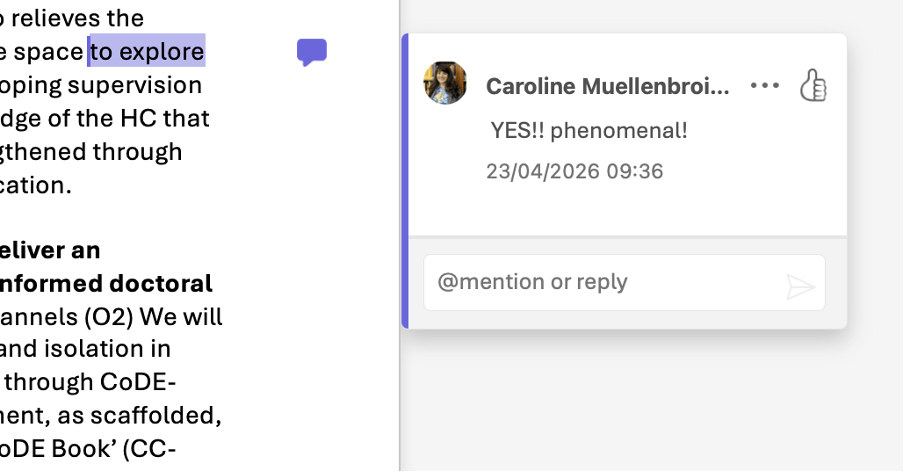
4. Note all the great points too! In a sea of edits and constructive comments, don’t underestimate the power of celebrating what you enjoy about the proposal. You never know how much someone’s day of redrafting can be turned around by finding a virtual high five in the comments.
5. Use “and”, not “but”
The word “but” often cancels what came before it. We are so attuned to it we can hear it coming before it is spoken. The word “and” can be transformative in creating continuity, forward momentum, and possibility, feeling more like an additional gift than a contradiction. This simple linguistic shift can dramatically change how feedback lands.
Compare:
“The project is ambitious, but the methodology needs more detail.”
With:
“The project is ambitious, and providing more methodological detail would help reviewers feel confident that it can be delivered.”
One feels disappointing, the other shows how to go from good to great.
Overall, remember that your expertise has value you can communicate, and proposal writers have hopes and fears that we can attune to. Research professionals are not mechanical assistants in the grant development process, nor are we the baddies, even when we have to be the gatekeepers. When feedback is offered in the spirit of partnership, mutual respect, and shared ambition, it builds not only stronger bids, but stronger collegial relationships.

