
By Cristina Vazquez Martin, InFrame Project Coordinator

This post covers what two years of InFrame taught me about curiosity, community, and the human side of interdisciplinary research.
When we talk about interdisciplinarity, we often focus on the outcomes: innovative ideas, new collaborations, and breakthrough discoveries. After two years working on the InFrame project, I have come to believe that the real challenge is not bringing different disciplines together. It is creating the conditions that allow people from different backgrounds to work together well.
InFrame brought together colleagues from the Universities of Glasgow, Edinburgh, and St Andrews, alongside researchers, research staff, postgraduate researchers, and research professionals from a wide range of disciplines and specialisms. On paper, this sounds straightforward. In practice, it meant connecting people with different priorities, experiences, languages, and ways of working.
What I learned is that successful interdisciplinary collaboration depends less on simply mixing expertise and more on cultivating relationships. The reflections that follow explore the role of curiosity, trust, diversity, community, and collective leadership in creating the conditions for meaningful interdisciplinary collaboration.
Collaboration starts with curiosity
Having spent many years as a biomedical scientist, I know how naturally curiosity comes to researchers. We are constantly seeking answers, testing assumptions, and exploring new knowledge within our research fields. What surprised me during my journey with interdisciplinary research was realising that the same curiosity is needed to understand people. Building meaningful collaborations requires taking the time to understand colleagues from different disciplines, listening to their perspectives, and appreciating how their experiences shape the way they think and work. Many of the most productive conversations I witnessed during meetings with the InFrame Project’s Culture Catalyst Fund (CCF) project teams I coordinated, began with simple questions:
“What challenges are you facing?”
“Why is that process important to you?”
“Can you explain how that works in your environment?”
These conversations helped people discover unexpected connections between their work. They also created trust, which is often the foundation for meaningful collaboration (Bond-Barnard TJ. et al., 2018). Trust acts as the fundamental glue for teamwork. Without it, groups only coordinate rather than truly collaborate. It enables psychological safety, transparent communication, and healthy risk-taking.
One of the most important lessons I have learned through my conversations with the InFrame Project’s Leaders is that curiosity thrives in environments built on trust. In my meetings with the CCF teams, I tried to be consistent in following through on commitments, transparent in my communication, and open about mistakes when they occurred. I found that actively listening, acknowledging different viewpoints, and responding with empathy often mattered more to trust-building than having the right answer. When people feel heard and respected, they are far more willing to ask questions, challenge assumptions, and explore new ideas together. This becomes even more important in interdisciplinary settings, where people bring different languages, assumptions, methods and ways of understanding the world. Trust and mutual respect self-reinforce to create the conditions for those differences to become a source of creativity rather than misunderstanding or division. When people feel comfortable admitting what they do not know, new possibilities emerge.
Further key lessons from my conversations with interdisciplinary CCF teams are below, under three headings.
Different perspectives are a strength, not a barrier
At times, colleagues from different disciplinary conventions approached the same challenge from completely different angles. Early in my career, I might have seen this as a problem that needed to be resolved quickly. Now I see it differently. When everyone approaches an issue in the same way, we often reinforce existing assumptions. Diverse perspectives encourage us to think more creatively and critically (Southworth et al, 2022). They can reveal blind spots and open solutions that would otherwise remain hidden (Bonner-Evans, 2026).
Some of the strongest ideas developed through InFrame emerged because people were willing to challenge each other’s assumptions respectfully and constructively. In practice, this meant asking questions rather than dismissing alternative perspectives, being open to different methods and forms of evidence, and treating disagreement as an opportunity for learning rather than something to be avoided. This kind of dialogue often helped teams uncover blind spots, refine their thinking and develop more creative solutions than they might have reached alone.
Building a collaborative community takes intentional effort
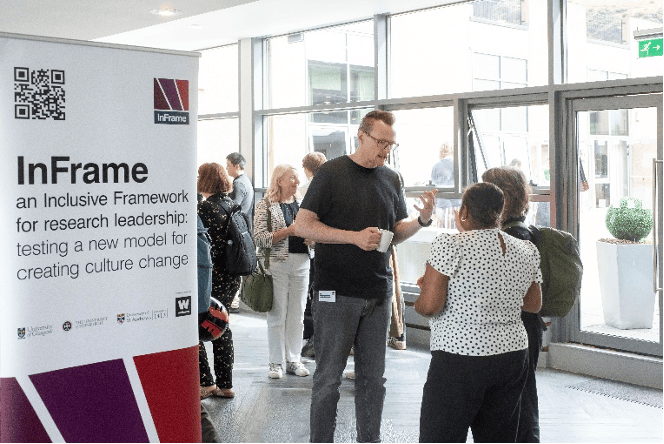
One of the biggest lessons from InFrame is that collaborative communities do not simply emerge because people share a project or funding stream. Community-building requires time, space, and support. Regular opportunities to connect, informal conversations, shared learning events, and recognising people’s contributions all play an important role (Wenger, 1998). These activities may appear secondary to project delivery, but they are often what makes collaboration sustainable.
When people feel valued and connected, they are more willing to contribute ideas, support colleagues, and explore new opportunities together.
Leadership can come from anywhere
Collaborative leadership and interdisciplinary mindedness are not limited to formal roles (Head, 2025). In interdisciplinary settings, leadership is often demonstrated through the ability to connect people, facilitate dialogue across different perspectives and create opportunities for collaboration. These contributions help teams work across disciplinary boundaries and develop solutions that would not emerge from a single discipline alone. Throughout the project, I saw researchers, research staff, postgraduate researchers, technicians, and research professionals demonstrate leadership in different ways. Some brought people together, others shared expertise, offered support, solved problems, or created opportunities for colleagues.
These contributions may not always be captured in traditional definitions of leadership, but they are essential to creating positive research cultures. Recognising these forms of leadership helps create environments where more people feel empowered to contribute.

Interdisciplinary research will always involve complexity. Different disciplines, institutions, and professional groups will continue to have different perspectives and priorities. Through my experience, I learnt that when we invest in trust, curiosity, and community, those differences become a source of strength rather than a barrier. Perhaps the most important lesson from InFrame is that culture change does not happen through frameworks and policies alone. It happens through people working together, learning from one another, and creating spaces where everyone can contribute.
And that is something every one of us can help build.
Gen AI Statement: Microsoft Copilot® was used to support drafting and editing of this blog post. The ideas, reflections, and final content are the author’s own.


‘creating spaces where everyone can contribute.’ A great final comment to this very interesting article.
LikeLike