
Pathfinder Professional Narratives is an ongoing series illuminating the career journeys and experiences of Research Professional Staff. You can see all of the posts in the series here.
This post is written by Inês Crespo, Research Communications and Engagement Lead in the College of Science and Engineering.
Relevant academic and professional qualifications: MSc in Environmental Engineering, University of Aveiro, Portugal (2006)
Approximate salary bracket for this type of role: £50,253 to £58,225
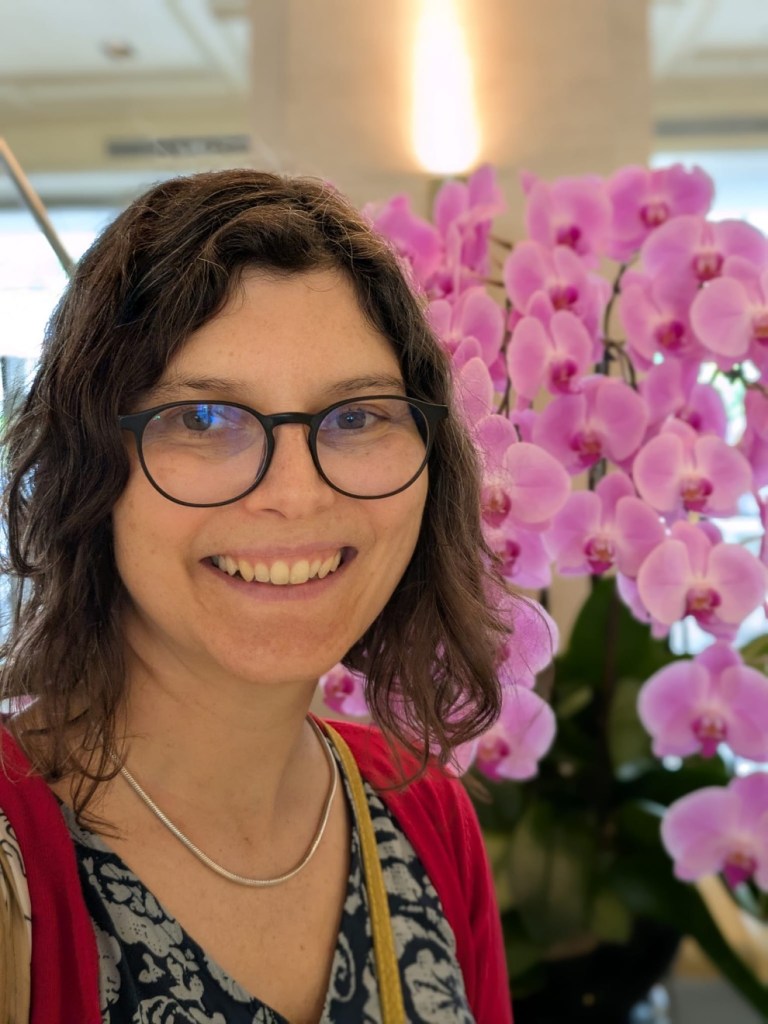
Back in 2001, I struggled to decide what university degree to pursue as I liked most STEM subjects. I chose a Master’s in Environmental Engineering in Portugal, my home country, mostly because I’d be able to keep studying all of the STEM subjects. Twenty-five years later, working as Research Communications and Engagement Lead for the College of Science & Engineering, in a role covering most STEM disciplines, it all makes sense. Moving from a career in Engineering to one in Research Communications across four countries is not easy to summarise in a blog post or make sense of on a CV.
Moving abroad (not so) temporarily
I’ve always been very attached to my family. I went home every single weekend when I was a student. So, when a friend and I decided to apply for a scholarship to spend six months abroad, that’s the most I wanted to spend away from Portugal. We worked for a small environment consultancy in Italy. Despite the beautiful trips, pasta and gelato, I found it hard to be away from my family. Yet, shortly after returning to Portugal, I was offered a traineeship at the European Commission’s Joint Research Centre (JRC), which took me back to Italy. Working at the JRC changed everything…
I made friends from all over Europe, who still are some of my closest friends today. I ended up working there for four years, conducting research into climate change communications. From then onward, I stopped thinking about returning to Portugal. It was also there that I realised I wanted to work in science communication and I then spent four and a half years as Communications Manager for a multi-million-euro neutron research project at the Technical University of Munich, before taking up a permanent role at the Roslin Institute, University of Edinburgh.
Working at Roslin came with unexpected opportunities for my development, such as becoming a representative to speak about equality, diversity and inclusion initiatives at international events, organising sessions at high-level events, supporting MP and MSP visits, and managing communications interns. I also joined the JRC Alumni Committee and learned a lot from ‘interviewing’ senior leaders to decide whether to feature them at our events. Seeing how others behaved and talked – often ignoring the core questions to ensure they said what they wanted to highlight to us – was a great lesson.
I also developed through work outside of my university role. As many others during the pandemic, I felt a need to do something good for other people. In my free time, I became Head of Marketing of a Brazilian organisation called Jadir Taekwondo Association (AJTKD), which gives free taekwondo classes to children from deprived areas, incorporating UN Sustainable Development Goals. AJTKD received the first BBC Green Sport Award, following an application I helped prepare. I’m still involved, mainly chairing side events linked to larger UN events.
Negotiating career progression through difficult decisions
After five happy years in Roslin, it was time for me to think about career progression. After many job applications, I was finding it difficult to be shortlisted for interviews. So, I took the difficult decision of accepting a job offer for a non-permanent role, for the same salary, because it gave me the opportunity to manage the comms team. I moved to Scotland’s centre of expertise on climate change, which bridges work with policymakers and researchers. That job taught me a lot about knowledge exchange, impact and engaging policymakers.
Three years later, when there was a risk that my contract might end (it didn’t after all), the University of Edinburgh offered me career coaching sessions, which were available to staff at risk of redundancy. This really helped make my CV more appealing to employers. I went from rarely being shortlisted for interviews to being offered three jobs within the same month.
The first offer happened by chance. I was considering whether to start freelancing and contacted the CEO of a consultancy called FRESCI, whom I met through the JRC Alumni Network, to ask him about tax. It was great timing because he was looking for a senior comms expert and I ended up freelancing for them for a year. That move wasn’t an easy decision though. At the same time, I received a job offer from the University of Edinburgh – a more secure prospect, yet again the same job grade and similar work. The idea of supporting startups in the medtech space through FRESCI felt much more exciting. However, they were only looking for a few hours a week. This is where I put my (limited) negotiation skills to the test and, for the first time, they worked! I negotiated the salary with FRESCI and asked ClimateXChange to reduce my hours to 30h/week, over four days, so that I could work for FRESCI on Fridays.
Consultancy life
I learned lots from working for FRESCI: using new project management systems, planning communications for industry events, business development, using AI for audio and media generation, and working at a faster pace than it is possible in larger organisations. Just about a month after I received the FRESCI offer, the University of Glasgow advertised my current job. As I live in Edinburgh, deciding to apply for a job nearly two hours from home wasn’t easy, but it was a great opportunity for career progression. So, I applied thinking it was better to decide only if or when I received a job offer. And I did!
Given that the work aligned closely with my new role, my line manager was happy for me to keep freelancing for the rest of the year. It wasn’t easy to balance both jobs and I often had to work out-of-hours to make sure I could get all my freelance work done, but the skills and experience I gained were worth it.
Responsiveness not planning
I love my job. It’s a role I have helped shape, and it allows me to work with teams across research, innovation and industry engagement, drawing on experiences I’ve gained throughout my career, while allowing me to keep challenging myself. If someone had told me back in 2001, when I was struggling to choose a degree, that I’d end up working across four countries and leading research communications for a world-leading university, I wouldn’t have believed them. What made the difference wasn’t having a detailed career plan. It was taking opportunities when they arose (even if they felt risky), reaching beyond my day job, and learning from people around me, colleagues, contacts, mentors and mentees. Those experiences have shaped my career and even led to my election as Co-Chair of the UK’s STEM PR Association (Stempra) – something I still find hard to believe. My biggest learnings from the past 20 years have come from opportunities that didn’t appear in my job descriptions.

