
Pathfinder Professional Narratives is an ongoing series illuminating the career journeys and experiences of Research Professional Staff. You can see all of the posts in the series here.
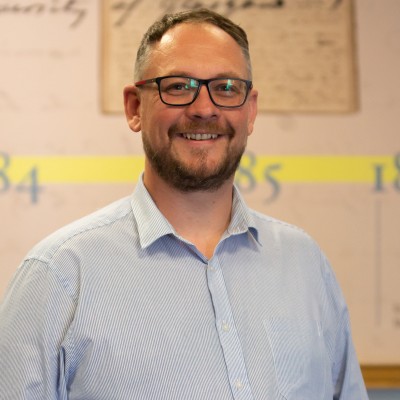
This post is written by David Pollock, Senior Industry Engagement Manager in the College of Science and Engineering Research Support Office, University of Glasgow. Connect on LinkedIn.
Approximate salary bracket for this type of role: £50,253 to £58,225
My career didn’t start with a clear plan, it started with a discarded CV. At 19, after finishing a college course in Sound Engineering, I was considering university when I came across an advert for a sales trainee open day with Reg Vardy (car specialist) in Glasgow. When I arrived, there were hundreds of people in the room. We were asked to bring our CVs to the front, where they were immediately thrown away.
The message was simple: who you are matters more than what’s written on paper. By the end of the day, after a series of group exercises the room had been reduced to around 20 people, all offered jobs. It was an unusual experience, but one that stuck with me. It challenged my assumptions about qualifications and showed me early on the importance of mindset, attitude, and interpersonal skills. At the time, I didn’t fully appreciate how much that lesson would shape my career.
Learning what really matters in work
I began my career in high-volume used car sales: fast-paced, competitive, and at times unforgiving. It was very much an ‘everyone for themselves’ environment, which didn’t naturally fit how I wanted to work. A turning point came when I shadowed one of the company’s top salespeople. His approach was fundamentally different. Rather than focusing on transactions, he focused on relationships. He remembered his customers, their interests, families, and preferences and used that understanding to build genuine trust. Customers would return and wait specifically to speak with him.
It was the first time I truly understood the phrase: people buy from people.
That shadowing experience really changed my perspective. I realised I was less motivated by quick wins and far more interested in building long-term relationships based on trust and credibility something that has shaped every role I’ve held since including my current role where I manage relationships with industry partners and their interactions with the college. This sees me linking to people through multiple routes of entry to the university from funded PhD students to managing large scale strategic partnerships and multi-million pound research hub partners and managing how best to leverage industrial income as part of that.
Developing skills that travel
Back to where we were, I took that relationship-building mindset back into my sales role and began to see results quickly. Over time, I progressed through the ranks and was eventually headhunted to join a new Nissan performance centre in Glasgow. One of the biggest lessons from this period was around visibility and self-awareness. Sales is an environment where your performance is constantly measured and through that you are made visible. Every month resets your performance, and you must be able to explain your value. At times, this pressure felt intense, but it forced me to reflect on what I brought to the table. Through this, I began to move away from thinking about me as my job title, and started focusing on my skills, which included:
- Relationship building and trust
- Communication and storytelling
- Negotiation
- Understanding needs and matching solutions
- Presenting complex ideas clearly
These are all skills that while they may not have a certificate attached to them, I have found to be exceptionally important, even more so in today’s environment of emails and Teams and quick transactional contacts where building relationships can be forgotten. I find it interesting to notice how these can make a difference in various working scenarios, perhaps you also are now thinking how these ideas fit with your role?
Stepping into the unknown: the energy sector
This shift to a value-added mindset became crucial later in my career when moving across industries. After some time, I felt ready for a change. I began exploring roles outside the motor industry and moved into SSE, working in consumer energy management. This was a significant shift, and I remember feeling completely out of my depth at first. I had no technical background in energy systems, and I questioned whether I’d made the right decision. However, the role quickly showed me that the skills I had developed were transferable. Much of the work involved supporting people experiencing fuel poverty, often through home visits and helping them understand and reduce their energy costs. What stood out to me was that my impact didn’t come from technical expertise it in fact came from my ability to build trust, ask the right questions, and bring people together.
Taking a risk and learning from failure
After several years, I felt the need for another challenge. A friend approached me with an idea for a new type of electrical fitting, and I joined his business as Sales and Marketing Director. It was one of the biggest risks I’ve taken.
We were a team of three, with no experience in product development, manufacturing, or regulation. Everything we needed to learn, we learned from scratch. This period was both exciting and difficult. For the first time in my career, failure wasn’t occasional, it was constant. Designs wouldn’t work, prototypes failed, and progress could be slow and uncertain. I remember moments of real doubt, questioning whether we were pushing in the right direction. But over time, I came to see failure differently. It wasn’t something to avoid, it was something to learn from. Eventually, we achieved our goals: BSI accreditation, an innovation award and a highly coveted place on Dragons’ Den scheduled for March of 2020… Then lockdown arrived, we received an email from the BBC telling us our Dragons Den trip to Manchester was postponed and everything changed overnight.
When the pandemic hit, we had to adapt our approach, pivoting from manufacturing to a licensing model and ultimately securing a deal to bring the product to market. While the outcome was positive, the experience also prompted reflection. Running a business came with sustained pressure, and it made me again reconsider what I wanted next from my career and work-life balance.
Finding my fit at the University of Glasgow
While considering my next step, I came across a role at the University of Glasgow: Industry Engagement Manager. One of the criteria was a PhD or equivalent experience. Initially, I found this intimidating and assumed I might not be a fit for the role. But instead of ruling myself out, I focused on what I could offer. I built a case around my experience, demonstrating depth of skill, impact, and adaptability. That decision paid off! I was offered the role and joined in March 2022. I have since progressed to Senior Industry Engagement Manager, leading on strategic partnerships and industry engagement.
At its core, my role is about translating complex research into clear, practical opportunities and building the relationships that make those collaborations possible. I work with a wide range of people from early-stage researchers to senior industry leaders and spend my time meeting academics to understand their research ambitions; engaging with industry partners to explore collaboration opportunities; developing strategic partnerships; translating complex ideas into clear, practical opportunities; and, supporting projects that connect research with real-world impact. One of the most rewarding aspects of my role is its variety and the opportunity to work at the interface between academia and industry. A week for me typically includes:
- Engaging with academic colleagues to understand research strengths and identify commercial or collaborative opportunities
- Building and managing relationships with industry partners, from SMEs to large organisations
- Supporting strategic partnerships that connect research with real-world challenges
- Working on programmes such as Knowledge Transfer Partnerships (KTPs), enabling impactful collaboration between academia and industry
- Representing the university at conferences, events, and international engagements
Points of pride
Looking back, I’m most proud of successfully transitioning across multiple industries, taking risks, particularly in starting a business. I’m also proud of my success helping secure large research projects and strategic partnerships. And I’m proud of the fact that I have progressed into a senior role without traditional academic qualifications. Each of these points reflects the same underlying theme, trusting my skills, even in unfamiliar environments.
If I were to offer a few takeaway points:
- Transferable skills are more powerful than you think
- Relationships underpin every successful career
- Failure is part of progress, not the opposite of it
- Don’t rule yourself out of opportunities too quickly
That early mentor in sales had a lasting impact on me. His focus on relationships shaped how I approach every role I’ve had since. More broadly, I’ve been fortunate to work with people who valued curiosity, effort, and authenticity over credentials, this has helped shape my confidence to take on new challenges. My career hasn’t been linear, and it certainly hasn’t followed a traditional path. At times, that has been a bit uncomfortable, but it has also been my biggest strength.
 The Auditorium: a research culture and researcher development blog