
By Dr Karen Gordon, Talent Lab Project Officer and Researcher (Psychology)
Beginning a career as an early postdoctoral researcher is often characterised by uncertainty and precarity. Researchers are expected to navigate complex career landscapes, make strategic decisions, build networks, and develop leadership skills whilst simultaneously growing their academic profile through research outputs. The wider context is that this is often required whilst working on fixed-term and precarious contracts, which research has linked to increasing challenges for researcher wellbeing and development (van der Weijden & Teelken, 2023; Nicholls et al., 2022).
Postdoctoral researchers are therefore under a huge amount of pressure to perform, often with limited structured support for them to take time to reflect on their wider career and professional development.
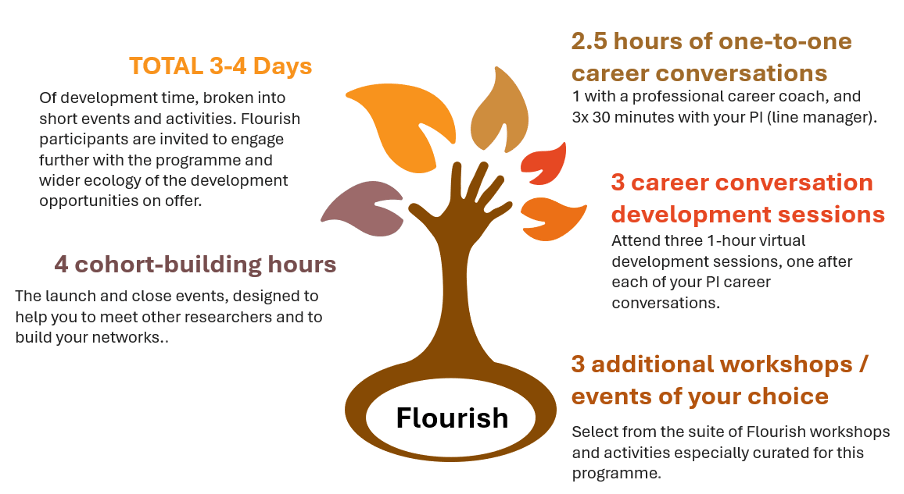
Career development is often framed as an individual responsibility, with researchers expected to be proactive and strategic in navigating their career journeys. However, what is discussed less frequently is how institutions can intentionally create conditions which support researchers to develop that agency in practice through structured opportunities for reflection, support and career planning. This blog post will detail the evaluation of Flourish 2025, a structured 5-month career development programme for early postdoctoral researchers (see Figure 1 for programme outline). The cohort comprised of 35 researchers, who completed evaluations pre (100% completion rate) and post programme (89% completion rate), whilst providing direct feedback on specific workshops attended. The evaluation has led to valuable insight into what supports researchers to navigate their careers with greater confidence and intention.
Creating space for reflection
One of the strongest themes from the Flourish evaluation was the importance of protected reflective space. Researchers consistently described how the programme enabled them to step back from immediate pressures and think more intentionally about their long-term development.
“Completing the Flourish programme has helped me take a much more proactive and intentional approach to career development. I now think about my career as something I can shape through continuous learning and small, consistent actions rather than waiting for opportunities to appear”.
This shift from reactive to proactive career thinking was central throughout the findings. Participants discussed gaining greater clarity regarding their skills, values, and future aspirations. For many, this included reassessing how their career ambitions aligned with their personal priorities.
“Before Flourish, I tended to frame progress mainly in terms of outputs and short-term goals; the programme pushed me to step back and interrogate why I’m pursuing certain paths, not just how. I’m more explicit about my strengths, the kinds of problems I want to work on, and the environments where I can realistically do my best work”.
Taking time to pause, reflect, and engage meaningfully with their development was hugely beneficial for Flourish participants. Creating dedicated time and space for reflection is a necessary component of sustainable career support and development.
Enacting agency
Career development support is frequently focused on providing information about opportunities and pathways. Whilst this remains important, the Flourish evaluation suggested that confidence and agency develop not only through access to information, but through structured opportunities to actively engage with career planning.
Participants described increased confidence in identifying their skills, pursuing development opportunities, and making strategic career decisions. Researchers discussed the practical steps they planned to take following the programme, including seeking mentorship, applying for further development opportunities, strengthening networks, and creating structured career plans.
“I’m more comfortable exploring different paths and feel reassured that I can make informed decisions that align with my strengths, values, and long-term aspirations”.
Importantly, this extended beyond academic career pathways. Researchers valued being supported to explore multiple opportunities without positioning careers beyond academia as a ‘failure’ for exploring and considering these alternative routes. Instead, participants were encouraged to think critically about what environments, values, and forms of work aligned best with their goals and strengths. Participant’s agency was viewed not only within identification of further opportunities, but within increasing confidence to take next steps which align with their personal values.
Community as a form of career support
Alongside structured reflection and development activities, participants repeatedly highlighted the value of peer community throughout the programme.
The postdoctoral experience can often feel isolating, particularly when researchers are navigating similar uncertainties. Flourish intentionally incorporated cohort-building, peer discussion, and alumni networking throughout the programme, which researchers consistently described as highly valuable.
“Having a strong network of mentors and peers doesn’t reduce the precarity of postdoc careers but somehow lessens the isolation and helps you see paths forward”.
Career development is often approached as an individualised process, but the evaluation findings suggest that collegiality and community are equally important components in navigating the postdoctoral career landscape. These opportunities strengthened both wellbeing and professional confidence. In this sense, community should not be understood as simply an addition to development programmes, but as part of the infrastructure which enables researchers to navigate career uncertainty more holistically.
Supported career conversations and coaching
Structured career conversations emerged as a particularly valuable aspect of Flourish. Through supported discussions with PIs and one-to-one coaching, researchers were given dedicated space to reflect on their goals, aspirations, and next steps. Participants described feeling more confident approaching career discussions and better equipped to articulate their development needs.
“The PI Career Conversations…helped me approach career discussions with much more confidence and structure”.
“The 1:1 career coaching session gave me personalised guidance and helped me clarify my priorities… I left the session feeling more focused, supported, and confident”.
The findings highlight the importance of creating intentional spaces where researchers can discuss career development openly, reflect on their aspirations, and plan strategically for their future.
Supporting researchers to flourish
The findings from Flourish 2025 suggest that effective career development programmes do more than provide information or training opportunities. They create structured conditions which support researchers to reflect, connect, build confidence, and develop agency within uncertain and highly pressurised environments. For researcher and careers developers, these findings reinforce the value of embedding reflection, community, and structured career conversations alongside skills development. Whilst for PIs, they highlight the impact that dedicated career discussions can have on researcher confidence and planning. Flourish offers an important reminder: supporting researchers is not only about helping them progress to the next role, but about helping them navigate their careers with greater clarity, confidence, and connection.
 The Auditorium: a research culture and researcher development blog