
By Dr Cristina Vazquez Martin, InFrame Project Coordinator
I want to begin this blog post by sharing why interdisciplinarity matters so much to me and why I believe it sits at the centre of what we’re building in the InFrame Project.
Before working in higher education, I spent many years as a researcher across academia and industry, moving through roles in cancer research and neurodegeneration. In those years, I learnt a lesson: some of the most important problems we face are simply too complex for any single discipline to solve alone. I remember working on Parkinson’s disease and feeling very frustrated. Despite decades of big efforts, major investment, and countless dedicated teams, the first treatment offered to newly diagnosed patients is still dopamine. This is a symptomatic treatment approach developed almost 70 years ago. It can be disheartening to witness slow progress when research is constrained to a single viable approach. This is not due to a lack of effort from Parkinson’s researchers, but rather the limitations of the pathways currently available. Meaningful breakthroughs often arise at the intersections of diverse disciplines – through an interdisciplinary approach (Madhu et al, 2022).
My experience has stayed with me. It taught me that to make real progress, whether in science, leadership, or culture, we need perspectives that complement, challenge, and expand each other. That is the true power of interdisciplinarity: it helps us see together, what we alone cannot. But interdisciplinarity doesn’t happen just because we wish for it. It requires us to purposefully create an environment where people feel able to share ideas, ask questions, and step outside their comfort zone. It is the product of a research culture that values connection, collaboration, and curiosity over silos and hierarchy.
Making the invisible visible: barriers to interdisciplinarity
I came to understand these cultural conditions more clearly through my work with X‑Net, an interdisciplinary research network focused on removing barriers to progress in biomedicine. Through interviews, surveys, and workshops, we identified the previously hidden obstacles interdisciplinarians face when crossing disciplines. To help visualise these challenges, we created the Interdisciplinary Wheel of Privilege, which shows how uneven power and support can be across roles and disciplines.
In the wheel, the inner rings represent positions that are more supported and privileged; the outer rings show where support thins out. Arrows point inward to indicate that the closer one is to the centre, the more resources they tend to have.

Among the biggest barriers we identified was the lack of support to develop interdisciplinary leadership, something highlighted in the report ‘Overcoming Barriers to Interdisciplinary Research’ (X-Net, 2022), in particular by early career researchers. As one participant put it: “Institutions need to be mindful of who they recruit into leadership positions. Appointing people who are willing to enable interdisciplinary research—and who work to connect people and ideas—is essential.” Another participant highlighted the difficulty of navigating institutional support: “Training resources are often challenging to identify, hidden on inconspicuous web pages or offering general advice that’s hard to put into practice. This may be where coaching or mentorship could really help.”
Without clear processes for collaboration across disciplines, and inclusive practices to ensure all researchers can take advantage of the available support, interdisciplinarity stays theoretical instead of becoming everyday work.
Why interdisciplinarity sits at the heart of InFrame
Recognising these obstacles helped me understand that interdisciplinarity doesn’t fail because people fail to put in effort. It fails because the environment isn’t set up to support it. InFrame was created to help change that. It is not just a single project, it’s an invitation to rethink how we work, lead, and learn across boundaries, across multiple simultaneous projects. By bringing together different disciplines, professions, and lived experiences across the Universities of Glasgow, Edinburgh, and St Andrews, we are building the cultural foundations that allow interdisciplinary work to thrive. When people from different worlds come together with openness and support, new ideas emerge, new leaders grow, and new possibilities unfold.
I want to highlight an important duality at the heart of InFrame: interdisciplinarity is built into the project framework, and it is also expressed through all of the 26 Culture Catalyst Fund (CCF) projects that it supports. InFrame provides the environment, the principles, and the leadership development provision that enable interdisciplinary collaboration to flourish. The CCF projects then put those support structures into practice, showing what interdisciplinarity looks like on the ground, across teams, methods, and disciplines. Together, we demonstrate that working across boundaries is not just an aspiration but a reality, that is both shaped by, and in turn is shaping, the culture we want to build. For example, InFrame builds interdisciplinary bridges through:
- Leadership development that equips new and emergent leaders to convene across disciplines
- Evaluation design that credits collaborative labour, not just individual outputs.
- Open infrastructures (e.g., using creative commons licencing, and shared templates) that normalise transparency and versioning.
- Narratives of recognition of good practice that celebrate the often-invisible work that sustains a collegial research culture.
Rather than just suggesting interdisciplinarity, the CCF specifically funded it. Many of the projects (read about all of them here) bring together key interdisciplinary combinations, such as:
- STEM + Social Sciences: to interrogate how technical and social systems co‑evolve. CCF projects: “Transforming research: The effects of sharing facilities on cultures and outcomes”, “Games for Research and Interdisciplinary Dialogue (GRID)”, “AI for Academic Synergy: Improving Discovery of Expertise and Collaboration Opportunities Across the Research Ecosystem.”
- STEM + Clinical/Health Sciences: physics with medicine, imaging, and clinical needs. CCF projects: “Bringing physics forward in medicine: recognising the value of physics as a pathway to research leadership”, “Student led Workshop Series: Multimorbidity & Advanced Care Interdisciplinary PhD Programmes.”
- Technical expertise + institutional strategy: facility management, equipment sharing, costing models, sustainability. CCF projects: “Research Technical Professionals: Recognising Leadership & Expertise (RELAX)”, “Creating the Scottish Research Technicians’ Professional Academy (SRTP).”
- Psychology + EDI/leadership studies to connect values, history, and design. CCF projects: “Restore: Reducing barriers and stress in the Research Misconduct process”, “Disrupting leadership hierarchies using Reverse Mentorship.”
- Arts‑based methods + data analysis: futures literacy, scenario planning, and game design supporting collaboration and culture change. CCF projects: “CoGIF – Creating generative conditions for imaginative research futures”, “Found Families in Academia: Women of Colour navigating higher education.”
An interdisciplinary super-connector
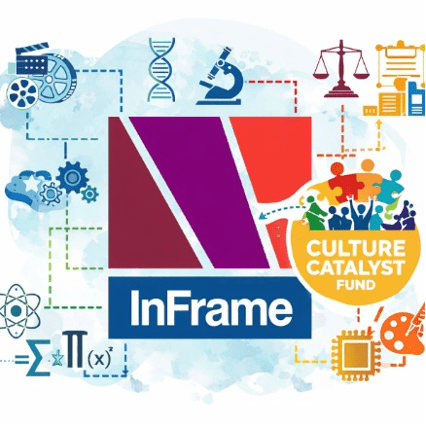
The figure below captures InFrame’s role as a super‑connector across the entire portfolio of CCF projects. By sitting at the centre of these diverse disciplinary clusters, InFrame is a conscious investment that acts as the bridge that links otherwise separate approaches, methods, and communities. The model shows how these interactions spark new ways of working together and enable a form of leadership that is collective, relational, and grounded in interdisciplinarity. Rather than a set of isolated initiatives, the projects become a networked ecosystem, with InFrame facilitating the cross‑pollination of ideas that makes genuinely transformative cultural change possible.

Across these projects, we have seen new ways of leading take shape, new connections made between open research, policy, and computing, and EDI work that is shaped by real experiences from different fields. The result is a complex and rich portfolio that isn’t just investigating culture objectively from the outside: it’s helping to reshape it through real processes that connect people across the research community.
One of InFrame’s core aims is to create a connected ecosystem with shared learning spaces and supportive peer‑to‑peer leadership. People, not projects, come first. When people work across disciplines, they don’t just share knowledge; they build trust. And trust is core to successful working across disciplinary boundaries and languages. Trust enables constructive challenge, generosity with expertise, and the courage to test new approaches.
The case for change
Interdisciplinarity is no longer optional; it’s fundamental to how progress happens. Interdisciplinary leadership is becoming essential for the future of research. The system ahead won’t be shaped by disciplinary silos but by people who can connect ideas and work confidently across boundaries. By nurturing cultures where collaboration is the norm, where support and trust are the rule, and where diverse expertise has room to meet, we can move faster and farther.InFrame exists to make that possible.
AI Note: Parts of this blog were edited using Microsoft Copilot (for content clarification) and Grammarly (for grammar revision).

