
By Dr Rachel Lyon, Researcher Development Specialist in English Language for Doctoral Writing
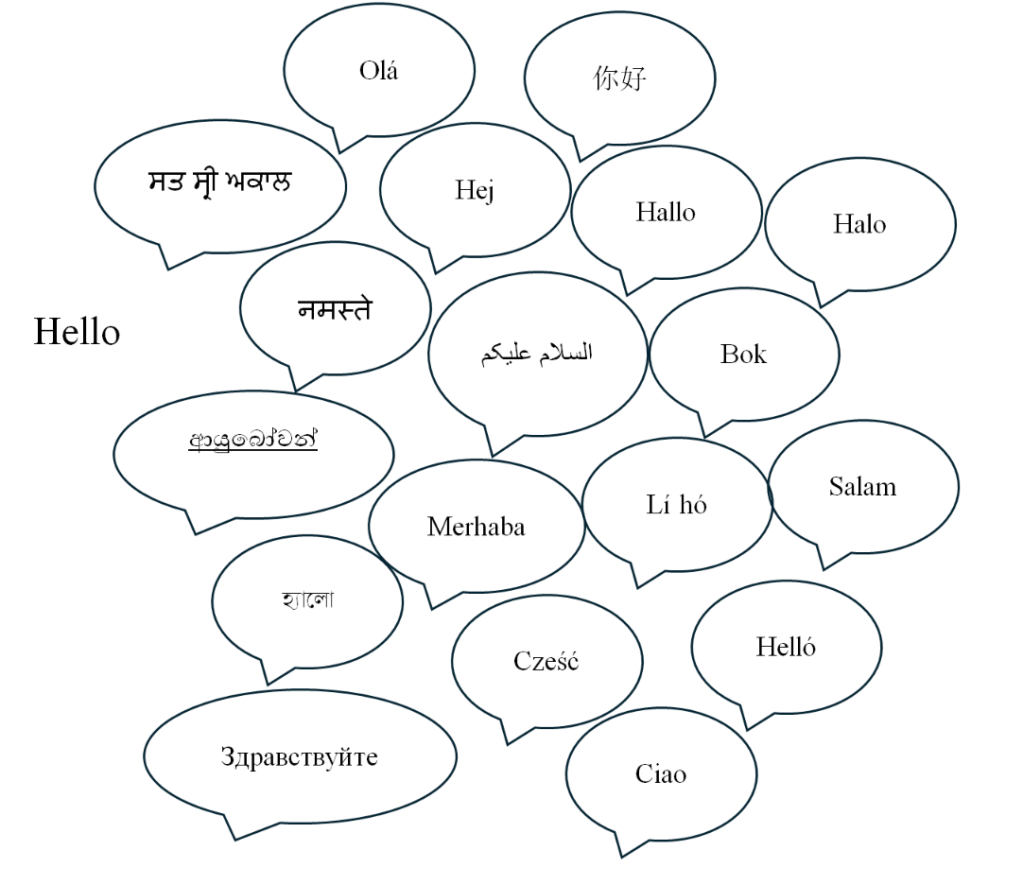
Hej, oli otya, salaam! How many languages can you use to say ‘hello’?
We are all rich tapestries of languages and knowledges. We are full of different ways of knowing, making meaning, and communicating our thoughts and feelings. It’s one of the most magical things about being human.
Even if you believe yourself to be monolingual (speaking just one language), consider all the ways you use your voice throughout the day. Think of how you use accent, tone or inflection depending on whether you’re at work or at home; how your word choices differ when speaking with friends or with your grandparents; or changes in your sentence structure, humour and gestural language whether you’re queueing for a bus or ordering food at a restaurant. All these ‘registers’ of our voice make up what linguists call our linguistic repertoire.
We don’t need to be fluent in a language for it to count either: all our ‘hellos’ are also part of our linguistic repertoire, and contribute to our tapestry of self. And of course, we don’t pick up or set down all these registers of our voice at will: whenever we speak in any context, we carry all of these parts of ourselves with us, as an intrinsic part of the tapestry of our being.
Those who speak more than one language, and can connect with all these registers of their voice across many languages, cultures, and contexts potentially hold an even richer linguistic repertoire. Because languages are connected to the way we think, they can open us to the knowledge systems, cultures and places with which they interact (systems known as epistemologies). Those with a wide linguistic repertoire are able to access a wide variety of ways of knowing, approaches to making meaning, and communicative styles.
What does this mean for a multilingual environment such as Higher Education?
In a research context, the potential benefits of embracing our linguistic and epistemological richness are manifold and far-reaching. More languages means we have more different ways of thinking, expressing ourselves, and understanding our experiences. This is capable of impacting on such diverse areas as:
- Research conceptualisation, theorisation, and originality
- Communicative, methodological and ideological innovations
- Approaches to knowledge building, meaning making and future thinking
- Ways of communicating across disciplines, places and communities
- Advances in pedagogy, research practice, leadership, ownership, community engagement, and our relationship with place
(among many others!)
So why aren’t we leaning in to this?
Unfortunately, UK Higher Education has not always been open to exploring these benefits. Instead,
- Linguistic diversity is often positioned as a deficit (a feature of wider linguistic injustice)
- Speakers who use English as a first language are afforded a position of superiority, while speakers who use English as an Additional Language are devalued (sometimes called ‘native speakerism’)
- Culturally dominant languages, as well as dominant cultural modes of knowing and communicating are privileged at the expense of others (a practice known as colonialingualism). For example, in UK-based institutions, we might find that we centre our attention on an English language canon, default to Anglophone research methodologies, or undervalue indigenous knowledges.
These structural inequities cause real harms to researchers using EAL who are prevented from using their full linguistic and epistemological repertoire in their research, writing and professional practice, and to the wider research environment itself which is prevented from evolving in response to these researchers’ contributions. In order to move forward as a sector, we must acknowledge uncomfortable truths, redress inequitable power balances, and centre the lived experiences of those who have been harmed. This is difficult work, which needs commitment, rigour and investment.
How can we become part of that shift towards inclusive and welcoming practice?
Approaching this critical issue in a meaningful way can feel overwhelming and challenging. However, we all have agency, and can make small but significant changes that will contribute to a wider collective effort around decolonising our thinking, reframing our shared narratives, and reshaping our professional relationships with researchers to value all the languages and ways of knowing we hold collectively.
Three small but significant changes you can make to your practice to begin creating change in your institution
Here are three critical actions we have taken through the EAL-PGR Writing Community at Glasgow that have created the conditions for meaningful, impactful and lasting change:
- Find out what languages your institutional community holds: At Glasgow, we recently ran a small pilot study on our collective linguistic diversity. Among 84 PGRs surveyed, we found 48+ languages, including African, Asian, European, and North and South American languages, and representing indigenous and dialect languages as well as larger global languages. This enabled us to enhance the visibility of our community’s languages within our institution, and begin advocating for meaningful changes in our institutional approach to welcoming, valuing and being inclusive of the linguistic strengths of our community. We are now planning to extend this pilot approach to data collection into our Annual PGR Survey, allowing us to develop a deeper understanding of a greater number of our PGR community’s languages.
- Listen deeply to researchers’ lived experiences around languages, and be prepared to act on what you hear: Use your position of relative power and agency within your institution to listen and to really hear the perspectives and lived experiences of the researchers you support. You might do this informally, through creating spaces for conversation. You might take a more structured approach, incorporating questions around languages, cultures and knowledges into regular feedback and evaluation mechanisms. If you have the time and space, you might consider a research project like the EAL-PGR Lived Experience Project that allows you to develop your critical listening practice even further. NB – listening should be first step in a sustained, evolving process of being responsive to what you hear.
- Create space to celebrate, value and champion linguistic and epistemological diversities: Within the EAL-PGR Writing Community at Glasgow, we acknowledge, appreciate and champion our writers’ linguistic diversity by:
- holding multilingual spaces in which all languages are welcome, valued and approached with care, curiosity and openness
- championing and validating using our full linguistic repertoires in our professional practice, opening us onto a wide range of ways to create and share knowledge – a practice known as translanguaging
- countering deficit narratives around those who use EAL, and international researchers by reframing multilinguality and diverse educational experiences as a benefit both for individual researchers themselves, and for the wider institutional ecology
- developing spaces of resistance within HE, where we can have difficult conversations, acknowledge complex truths, and build a new direction together as a diverse, inclusive and anti-colonial community
It can be difficult to believe that our actions can create change. But each of these small ripples of positive practice contributes to a wider narrative of collective mindset shift. Every researcher and colleague in our communal research culture should feel welcomed and supported to bring every thread of their linguistic tapestry to their research, writing and professional practice. It is our collective responsibility as a sector to make that possibility a reality for all of us.
 The Auditorium: a research culture and researcher development blog