
by Arianna Magyaricsova, PGR Intern and doctoral researcher in Archaeology
The PGR Lived Experience Project, June – October 2025, was designed to listen to, value and better understand the lived experiences of two key groups of PGRs at the University of Glasgow: Part-Time PGRs, and PGRs who use English as an Additional Language. Realised as a collaboration between Research Culture and Researcher Development and Research Governance, Policy and Integrity, the project was conceived as a staff-PGR collaboration, and centred a peer-led approach: PGR Interns took a leadership role in shaping the project strategically, designing the project methodology, and in gathering and analysing the data.
Arianna led on the Part-Time PGR branch of the project. In this blog post, she reflects on the project, and what she learned through being involved in this research.
Why I wanted to be part of this project
I applied to get involved in this project because my work in student-facing roles at the university has made me acutely aware of the challenges that arise when institutional systems do not account for the diversity of our PGR community. Through these roles, I have become deeply invested in student wellbeing and inclusive research cultures. Contributing to a project centred on the lived experiences of Part-Time PGRs (PT-PGRs) therefore felt both necessary and meaningful. It offered an opportunity to support equity in our research culture, by ensuring that often underrepresented voices can inform institutional decision-making.
Listening to part-time researchers
We focused on listening closely to the day-to-day realities of PT-PGRs at the University of Glasgow and understanding what those experiences cumulatively reveal about our systems and culture. We ran five focus groups, with PT-PGRs from a wide range of backgrounds, disciplines, career stages, and life circumstances. The discussions were intentionally peer-led and centred on themes such as time and access, community and belonging, support and communication, and identity. This approach created an open, reflective space where participants could speak honestly about their experiences and what mattered most to them.
What we heard, loud and clear
Across the focus groups, PT-PGRs expressed a strong commitment to their research. What they felt held them back were the norms and systems designed with Full-Time PGRs in mind. Many described moments of feeling unseen or overlooked in everyday academic life. As one researcher explained, “sometimes there’s a sense of feeling a bit invisible, I don’t feel part of the wider research community.”
Time and finance came out as major structural pressures. Many balance full-time work, caring responsibilities, and study, often using annual leave for research. Funding is limited, inconsistent, or unclear, leaving some feeling undervalued.
Experiences of belonging and identity varied widely. Supervisors were often the main anchors of support, with sense of belonging depending heavily on individual relationships. Communication added further pressure, with multiple systems and inconsistent messaging creating cognitive overload.
Participants also highlighted how institutional processes such as Annual Progress Reviews felt misaligned with part-time study patterns and mirrored expectations set for full-time trajectories. Many felt that key processes and information pathways did not fully reflect the rhythms of part-time research or the fragmented time available to those balancing work, care, and study.
Across all themes, we found the issues that PT-PGRs raised were structural. Faced with policies and procedures that may not have been designed with PT-PGRs in mind, the question becomes – How can institutional approaches evolve to better reflect and include the realities of part-time research?
Looking ahead together
Our findings suggest that improving the experience of part-time PGRs requires a commitment to their inclusion by design.
Participants were strikingly aligned on the areas where change would have the greatest impact. They emphasised the need for more predictable structures, for example, clear, university-wide guidance for Annual Progress Reviews, and early publishing of event calendars to enable planning around work or caring commitments. They also called for simpler, coordinated communication, ideally through a single information hub, supported by short curated updates.
Financial equity was also a central theme. Increasing availability of accessible funding, including targeted small grants would offer practical support and signal that PT-PGRs are valued members of the university’s research community. Participants highlighted the need for physical spaces and opportunities where they can meet other researchers, examples ranged from shared desks to flexible, low-cost gatherings.
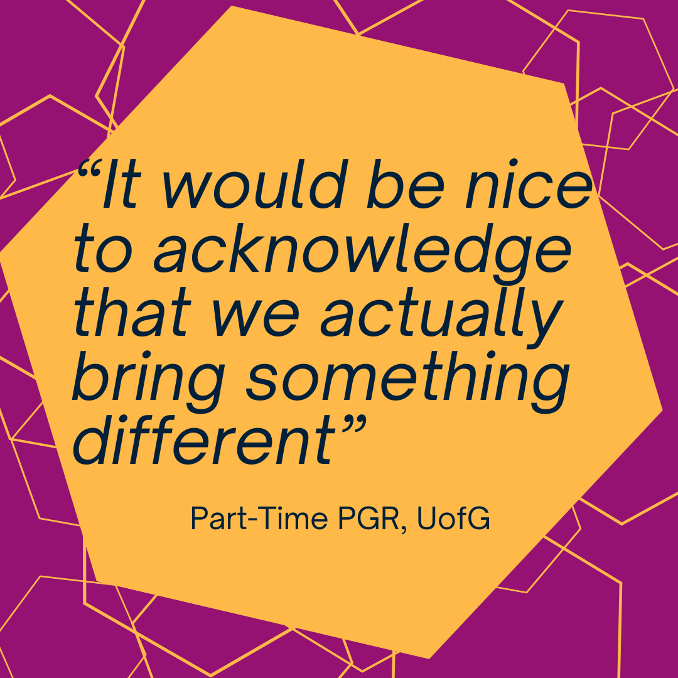
Finally, the importance of recognition. For example, named contacts in Graduate Schools, with a specific remit to champion PT-PGRs, increased visibility of part-time contributions, and a acknowledgement of the distinct value PT-PGRs bring to the university.
These recommendations represent a movement towards proactive, equitable and inclusive design, that understands the diverse realities of PGRs as a whole community and strengthens the University’s wider research culture. We are excited by the potential of this project to contribute to the strategic direction of ongoing work at UofG. ‘Part-Time, Full Experience?’ will allow us to bring a current evidence-base of PT-PGR lived experiences to conversations around inclusive research cultures, researcher wellbeing, and move towards equity of opportunity for all researchers.
What this project taught me
PT-PGRs bring depth, professional expertise, and perspective to a university’s research culture. Ensuring that they feel included and are supported to thrive like their full-time counterparts is an investment in research excellence.
Participating in this project has been an incredibly meaningful experience. Facilitating focus groups with PT-PGRs reminded me that inclusion often begins simply with being heard. As one participant expressed, “even this short discussion with others in the same position made me feel a bit more like a part of the community”.
It has reaffirmed for me that meaningful institutional change starts with listening and depends on designing inclusive structures that anticipate diversity.
 The Auditorium: a research culture and researcher development blog