
Hyab Yohannes, Lecturer in Forced Migration and Decolonial Education, UNESCO Chair RIELA, University of Glasgow
Every November we celebrate WriteFest, a national festival spotlighting writing in higher education. This year, we’re marking the occasion with a special blog series – How I Write – which highlights some of the diverse writing practices and approaches of colleagues across the University of Glasgow. Across the articles, you’ll discover how our authors approach writing, from the nitty gritty process of setting up a Word Doc for optimal collaboration, to grappling with the deeply emotive aspects of our need to write.
In this contribution to the series, Hyab approaches writing as a metaphorical space, and explores a context in which writing is a fundamental practice, as essential to survival as breathing. Content warning: this blog contains a brief description of violence and wounding, as part of a discussion of Hyab’s lived experience as a refugee.
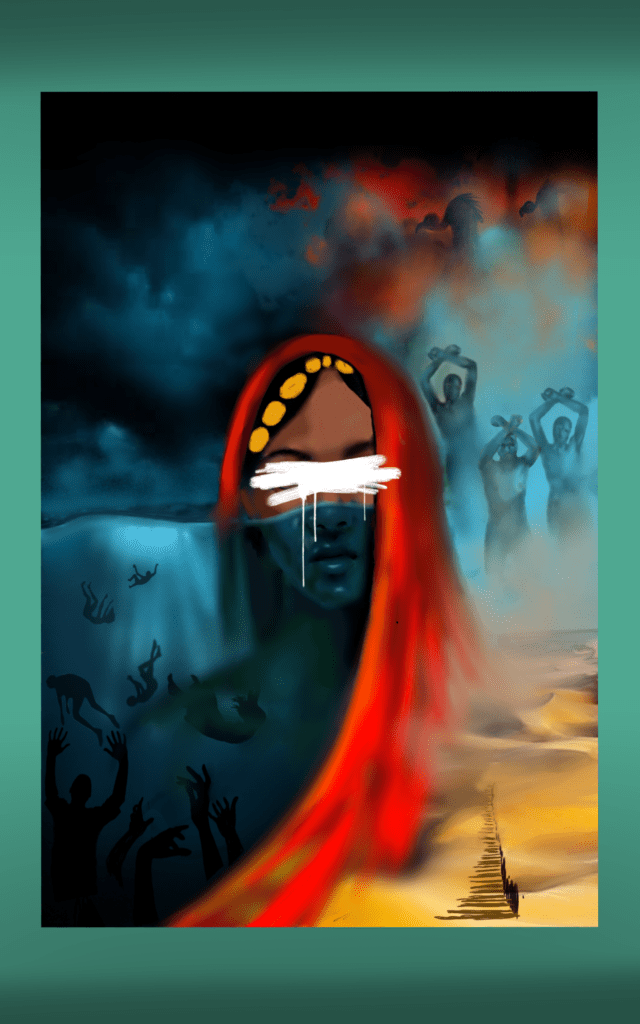
In this blog, I reflect on where my research is written from, and why I write at all.
From where do I write?
I write from within the belly of the refugee abyss, namely ‘spaces where calculated, contained, and deliberate death’ unfolds against those rendered disposable (Yohannes 2026, p. 2). These places include borders, refugee camps, torture sites, deserts, sea-camps, and asylum hotels. They are carceral spaces where wounds are inflicted, scars borne, suffering lived, and trauma made invisible. My writing emerges from these wounds, both my own and those of countless others whose displaced voices remain unheard. I write from exile, from the shadows of borders (physical and epistemic) and from images and memories of worlds shattered by war, forced displacement, and survival. I write at the crossroads of loss and traces of poetic resistance, the opacity of silence, and the displaced voices of testimony and witness.
My writing passes through many languages: my mother language of intimate relation, the oppressor’s language of silencing, and the colonial language that carries my uneasy thought. I write auto-poetically to reclaim displaced voices, to transform grief into knowledge, stories into poetic resistance, and loss into traces of possibility.
Why do I write?
I write because I breathe. Think with me, to understand what I mean. You arrive in the world as a child of wartime, in a colony where life is measured by how quickly it might vanish. At an age when most children run at play, you learn to run from bullets. At an age when most cradle toys, you cradle wounds. You hope for a ‘happy life’, whatever that might mean.
Then independence comes. You cannot join the celebrating children because you are nursing a fresh bullet wound, inflicted by a panicked colonial soldier. Later, you watch others walk to school. Soon, you will join them.
But this too comes to an end. And after, you live under a suffocating regime, where every breath feels borrowed. When your country condemns its people to indefinite service, forced disappearance, and exile, you flee. You cross the border bleeding, starving, breathless. In refugee and torture camps, you smell your own wounds laid bare to the bone, and the decomposing flesh of friends and strangers.
Alive, you perform your suffering to obtain refugee status. Your trembling fingers leave their print on a machine that archives your pain. Then, with resources and a voice, you stand poised to write about the abyss. How, what, and why would you write? I pause here, as you reflect. We are breathing.
.
.
.
.
Fanon reminds us that breathlessness is both a literal and figurative constriction (Black Skin, White Masks, 1986). It is a manifestation of inner turmoil and anxiety, born of suffocating ordeals inflicted upon living bodies. ‘Breathlessness’, Maldonado-Torres explains, is a ‘closeness to death, as in a condition of permanent torture’ (Maldonado-Torres 2016, p. 6). Beyond its physical sensation, breathlessness is a perpetual state of suffering and vulnerability, imposed upon those who are condemned into the unending abyss that stretches from slavery to colonisation to forced displacement. Writing of the experience of colonised bodies, Fanon explains: ‘What I found there took away my breath’ (Black Skin, White Masks 1986, p. 99). Such writing from within the abyss demands as Fanon writes, ‘a sharp intake of breath’ at the outset and throughout the writing process (p. 42). In this act of breathing-writing, every punctuation mark becomes a point of inhalation; every silence, a trace of a voice lost; every cry, a life extinguished.
Having lived through the ordeals of the refugee abyss (Yohannes, 2024), I find myself breathing-writing from within the abyss. There are traces of lived experience, of embodied knowledge and witnessing, that emerge in my breathing-writing not solely through detached intellectualisation, but from my breathing body, shaped by suffering, survival, and memory. These sensibilities, and the embodied knowing they summon, inform the praxis of my breathing-writing. I often write from the position of witness, but also from the site of the wound itself. I write to reckon with the wounds of the refugee abyss, and in this reckoning, I aim to be empirically grounded, theoretically poetic, and, above all, truthful and free. In her writing, Lorde offers this fundamental dictum: ‘I feel, therefore I can be free’ (Lorde 2018,p. 4). The yearning for unlived freedom begins with feeling and with dreaming.
In the praxis of breathing-writing, I refuse to accept the inferiority of my voice, nor do I claim its centrality. Rather, I reclaim my voice as one among many, the voices of those with whom I develop my thinking. I write with and alongside participants and collaborators whose breath continues to rise, despite every attempt to crush it. This plurivocal act of breathing-writing is a poetics of shared resistance, emerging from flesh and bone, rubble and ruins. Hence, breathing-writing becomes an archival, ethical, and poetic praxis, uncovering the traces of life and making visible what is so often ignored or erased. It enables me to trace and weave together the displaced voices of those who endure within the abyss. And when I am summoned to write about those lost to breathlessness, I lay my words down like stone-markings on the grave of what is lost, and also as a path for someone still struggling to survive. I lose myself in grief for those who did not make it, and in rage against the conditions that rendered their survival impossible. So that, when I finish my breathing-writing, I will have nothing more to lose.
 The Auditorium: a research culture and researcher development blog