
Elena Habersky, PGR in Political Science and International Relations studying urban migration of Sudanese to and from Cairo.
Every November we celebrate WriteFest, a national festival spotlighting writing in higher education. This year, we’re marking the occasion with a special blog series – How I Write – which highlights some of the diverse writing practices and approaches of colleagues across the University of Glasgow. Across the articles, you’ll discover how our authors approach writing, from the nitty gritty process of setting up a Word Doc for optimal collaboration, to grappling with the deeply emotive aspects of our need to write.
In this contribution, Elena Habersky shares how the city of Cairo where she is based, inspires the textured style of her writing and offers a reflective space to develop her writing practice.
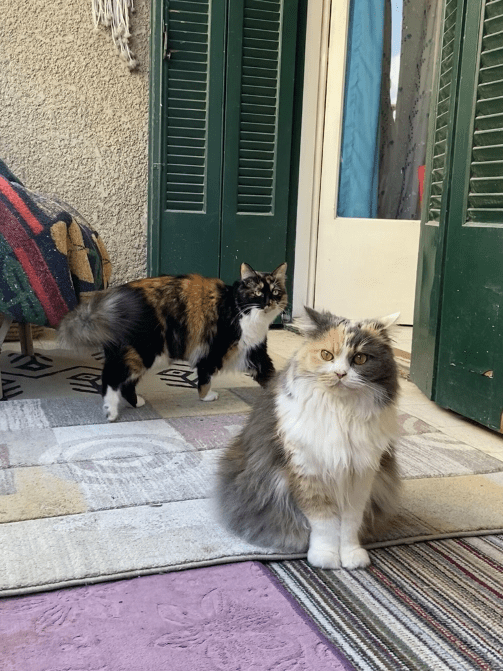
My favourite place in the world is my balcony. Having lived in Egypt for the past nine years, my balcony has been a refuge from the chaos that is Cairo. The mornings are the best; this is when I sip my tea and listen to the streets, four stories below, come alive as my two cats watch the birds take flight for the day; often teasing them before they fly away.
This is also where I love to sit and write. Often the internet does not reach outside the apartment walls and this is honestly the best for focused writing. It is just me and my memories, crafted into words; a constant dance between one another.
My words are not merely academic but a constant weaving of poetry and reflection. As I go through my field notebook, I try and craft haikus of what I see, anchored by my memories and photography. I reflect on what is important to remember and I consider what message I want readers to know from my experiences or from what people generously shared with me. I write this down in the standard 5-7-5 format.
Music and Good Food
Archiving Everyday Life
Sudan will live on
The words do not always flow easily, but I find they at least attempt to escape my brain through my fingertips once I am a bit creative – almost like an offering to the writing gods.
It is my hope, too, that my readers will connect first with the creative aspect of my writing so they can stay engaged throughout the academic context of it. We know, as academics, that our writing can be filled with jargon and put off most readers. Thankfully, I believe this is changing and that more academics are trying to make their work accessible without sacrificing content or meaning. Adaptation is a way of life, and academia is no exception. The sooner we realise and accept this, the better.
As my research is grounded in the urban, in the messy, wonderful unruliness that is Cairo, I find my balcony offers the perfect balance of the city while giving me some privacy to write and reflect (though can one ever have privacy with cats?)
Morning Offering
Sipping tea with a slight breeze
Cairo from above
In the mornings I can hear the men yelling their daily offerings of fruit and vegetables, ‘lemoooooooon,’ those that bang on the metal canisters selling Egyptian beans (fuul) for breakfast, and the father and son duo who yell to collect discarded items – ‘robabikya’ – which can be salvaged for money, (from the expression ‘roba vecchia’ which means ‘old stuff’ in Italian). ‘Bikya, Bikya,’ the son exclaims! It is always a delight when I am in the street, and I see the people I have been hearing for almost a decade, putting a face to the sound. I smile because I feel I know them, a connection based on voice alone. Is this not what we as authors hope for? That those who read our writing find a connection with our voice?
I savour these sounds, these voices, sadly ones that are slowly fading away as time and technology change old institutions. Yet, they somehow ground me in the place of it all. I cannot truly understand, let alone write about urban migration, a topic I have been invested in for the past twelve years, if I do not immerse myself in the cityscape itself. How can I write about the challenges and successes of my interlocutors: getting a residency card, enrolling in school, finding suitable housing, or accessing healthcare if I do not immerse myself in something similar? While my balcony may not show the cacophony of it all, and to be honest, for that I am often grateful, the brief glimpses are enough to inspire me and my writing.
My favourite times to write are away from the mid-day sun, either in the morning after the kids and neighbors go to school and work, or right before sunset. Cairo has the most vibrant sunsets, filled with oranges, yellows, and pinks. I am also blessed that there are ample trees around my apartment building, unfortunately something that is becoming a luxury in this ever-expanding metropolis. I love when the fire trees bloom in May or when the pink flowers come out to play in September. They are often a refuge for birds, street cats, and women selling local produce, and while they may not be everyone’s ideal of being in nature, I feel immense gratitude to be protected by their memory and shade.
This is my most important takeaway from balcony writing: to always establish one’s writing in a place of gratitude. Gratitude to write, to find the words, to share another’s experience through your analysis, and to have your words read.
Grateful for writing
My balcony as refuge
I love you Cairo
 The Auditorium: a research culture and researcher development blog