
Ellie MacPherson, Knowledge Exchange Lead, College of Social Sciences
Every November we celebrate WriteFest, a national festival spotlighting writing in higher education. This year, we’re marking the occasion with a special blog series – How I Write – which highlights some of the diverse writing practices and approaches of colleagues across the University of Glasgow. Across the articles, you’ll discover how our authors approach writing, from the nitty gritty process of setting up a Word Doc for optimal collaboration, to grappling with the deeply emotive aspects of our need to write.
In our first contribution, Ellie explodes the myth of writing as a starkly solitary activity.
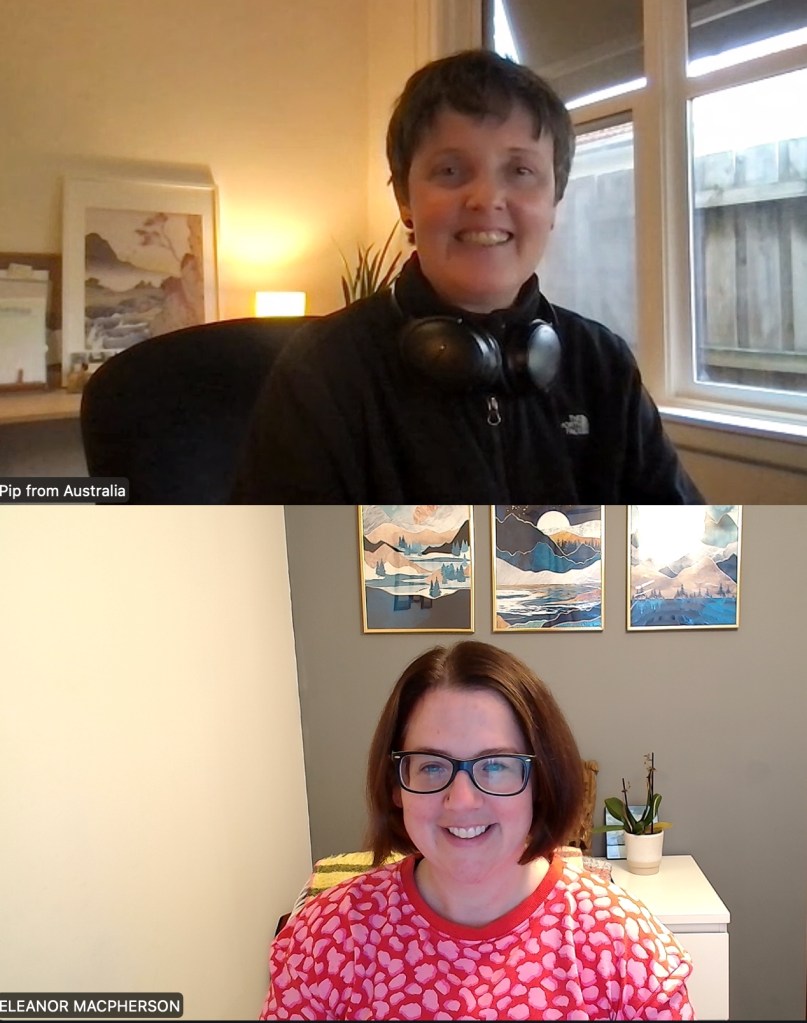
My favourite place to write isn’t really a place at all, but a time and a ritual. At 7am, fresh from the gym and with endorphins flowing, I open my laptop, log into Zoom, and greet one of my favourite people in the world: Pip, in Melbourne, Australia. As I’m starting my day, she’s winding down hers – our different but complementary energies often in sync. We’ve been writing together since 2020, and what began as a pandemic survival strategy has become one of the most important and sustaining practices in my work. It’s seen me through both an international move and a career change.
Overcoming writer’s block
Winding back to where my love for writing in company began, it was May 2020 when I developed severe writer’s block. At the time, I was working as a researcher in Global Health, based in Malawi during the COVID-19 pandemic. My primary-aged children had been out of school for months; I was thousands of miles away from family, and travel bans meant that if something happened, I couldn’t return home. Like many academics – especially those on research-only contracts – the pressure to publish and write grants was fierce. With the luxury of hindsight, I can see that I was simply responding logically to extraordinary circumstances, but at the time I blamed myself.
Before the pandemic, a senior colleague had mentioned writing retreats as a way to progress stalled projects. I filed the idea away until I began to notice virtual writing retreats emerging online, and decided to take the plunge. Joining my first retreat felt revelatory. As someone with dyslexia, I’d always had a somewhat fraught relationship with academic writing, but in that space, I felt calm and focused for the first time in years.
During this period, I saw a proliferation of virtual writing spaces, most often curated and populated by women. Meeting women from across the world, many balancing caring responsibilities and work under intense strain, offered what felt like a safe haven in a storm. The brief check-ins at the start of sessions created space to share our projects and challenges, and for the first time I heard people speaking honestly about their struggles with academic writing. It was reassuring to realise I was far from alone.
The groups also introduced me to valuable resources, such as Helen Sword’s (2017) work on writing as a learned craft – something we develop over time – and Wendy Laura Belcher’s (2019) Writing Your Journal Article in Twelve Weeks, which provided a practical framework I still return to. Looking back, it’s striking that it took me ten years into a research career to realise that writing is not an innate talent, but a practice that must be nurtured.
The power of companionship in writing
Writing with Pip grew from those early experiences. We met in one of the online retreats, and we’ve met almost weekly since June 2020, yet we have never met in person. But the regularity of our meetings has been invaluable – not just for productivity but for companionship. Knowing I have a safe space to discuss challenges, especially when I feel blocked with a project, often helps me move forward.
Another important element is the structure we follow: setting goals together at the start, checking in on progress at the end, and reflecting honestly on how projects are developing. In the structured approach to writing retreats, Rowena Murray (2015) calls this focus on monitoring work undertaken with ‘non-surveillance’. Writing in the company of others helps us stay focused and fosters a sense of shared purpose.
It also supports a more sustainable writing practice. As Joli Jensen, one of my favourite authors on writing, observes in her 2017 book, “[i]n order to be productive we need frequent, low-stress contact with a writing project we enjoy. Our problem is that academic life offers us the exact opposite: infrequent, high-stress contact with projects that come to feel like albatrosses.” Rather than viewing a writing project as a huge, insurmountable task, this approach helps me break it into manageable chunks and stay close to my work.
Since changing careers and moving into a research professional role, my writing projects have evolved. Yet the principles of non-surveillance, goal setting, and shared accountability that underpinned those early retreats continue to shape how I write. Having our cameras on while we work creates a gentle sense of accountability, as well as the quiet reassurance that someone else is there, writing too. These sessions ensure I carve out time for projects with a strong writing element, supporting all kinds of writing and helping me navigate different expectations and work demands.
From these experiences, a few lessons stand out for me:
- Routine matters: finding a consistent time and rhythm makes writing feel less negotiable and more like a natural part of the day. This has been particularly important now that I’m in a role with less control over my time and workload.
- Writing doesn’t need to be solitary: sharing space with others – whether through a retreat, a writing buddy, or an online group – brings accountability, motivation, and reassurance.
- Honesty helps progress: hearing others talk openly about their writing challenges normalises the process and creates psychological safety for reflection and growth.
I remain deeply grateful to Pip, who has been a constant writing companion and cheerleader across continents and time zones. These practices continue to sustain my own writing and remind me of the broader importance of nurturing writing cultures within universities – not only for academics but for all staff. Creating space for reflection and connection through writing can help us navigate the pressures of higher education and find joy in the process along the way.
 The Auditorium: a research culture and researcher development blog