
Dr Joanna Royle, Researcher Development Manager

What work tasks are you just naturally not very good at? I’ll go first.
My capacity for embedding factual errors in emails is legendary in my team. It doesn’t seem to matter how hard I try, back it will ping with “did you mean TUESDAY 12 August? Monday is 11 August”. The cold shame will flood down my back that this seemingly simple thing – correctly copying information from a calendar – has once again defeated me. On the other hand, if you need to send someone along to a meeting who will be super positive, upbeat, encouraging, and help make praxis connections between big ideas and their applications, I am your woman.
In other words, I am what in Belbin parlance is called a ‘Resource Investigator’, and very much not a ‘Completer Finisher’.
What is Belbin?
At Glasgow we use Belbin as part of our work to support Teams to thrive. Belbin is a model of nine clusters of work activities or behaviours commonly found across professional teams. Developed by Meredith Belbin, the model is based on almost a decade of research at Henley Management College about what makes a really effective team. His work tested everything, from psychometrics to IQ to personality to behaviour. He found that the most successful teams are not those with just the smartest people, the most experience, or the best technical experts. Instead, the teams who thrive are those with a strong balance and compatibility in the different roles their members play.
The most successful teams typically include a mix of all nine Belbin roles, with different ones coming to the fore at different stages of projects. Crucially, this doesn’t mean you need nine people on your team. In fact, Belbin found that the ideal team size is just four or five. The model encourages you to identify the cluster of roles that come naturally to each person and lean into those strengths. We can all stretch into roles that we don’t love but find manageable, but it becomes draining when you’re constantly operating outside your natural Belbin profile (case in point: me emailing out event dates!). Not only is it exhausting, but you’re also probably going to be pretty bad at it. Which is counter-productive, because chances are, someone else on the team finds those tasks easy and energising, freeing you up to contribute where you shine.
What does this have to do with Winnie the Pooh?
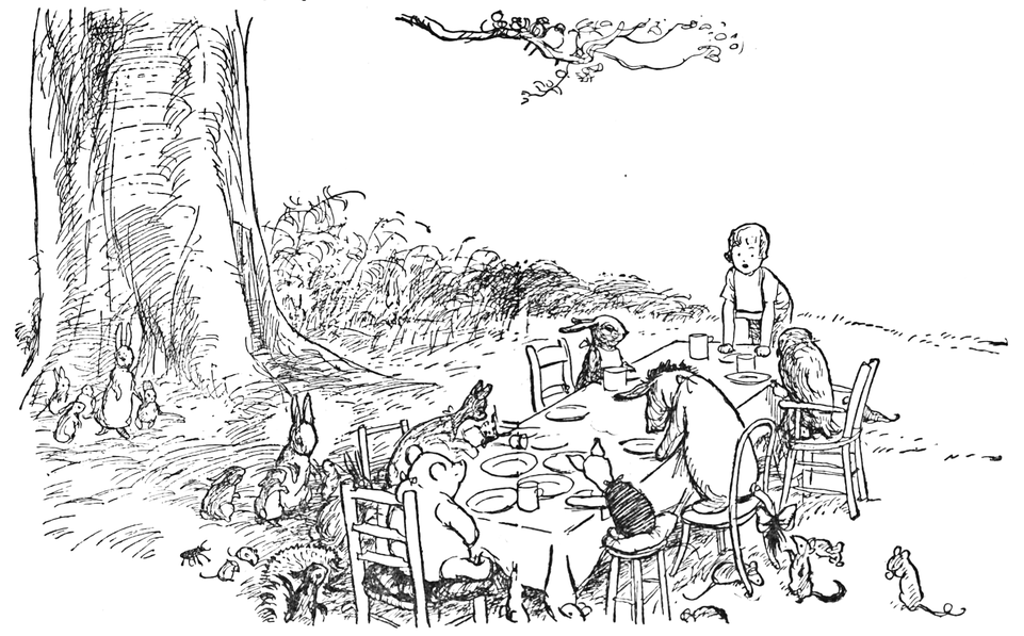
Officially, nothing at all.
However, second to my preference for being a Resource Investigator, I am a ‘Plant’. And Plants are the folks who come up with brilliant (and also sometimes daft) new ideas. When training to be a Belbin facilitator, I noticed that this favourite childhood book also has nine characters. Nine very different animal friends who work wonderfully as a team, navigating the challenging adventures of catching Heffalumps, navigating floods on make-shift honeypot boats, and going on quests (‘expotitions’) for the North Pole.
If you are not fond of an analogy, you can find the Belbin roles correctly described in business language here. However, if you like a playful foray, please enjoy AA Milne’s beloved characters as a Belbin Team:
🧑 Co-ordinator – Christopher Robin: Takes the lead on organising those expotitions to the North Pole and similar: Christopher Robin makes the plans and makes sure everyone is doing their bit
🐯 Resource Investigator –Tigger: Aways enthusiastic for a new adventure; bouncing about getting everyone involved
🐴 Monitor-evaluator – Eeyore: Thinks carefully about the long term implications, and can tell you where your plans will go awry
🦘 Implementer – Kanga: Reliable and practical, will always makes sure there are plenty of sandwiches on expotitions
🐇 Shaper – Rabbit : Driven and focused, giving momentum to the team “We’re starting, I must go. And he hurried off to the front of the expotition“
🐭 Plant – Roo: This little dreamer’s imagination brings a new way of looking at the world. He may fall accidentally into the river, but he sees it as a new chance for swimming
🦉 Specialist – Owl: Deeply knowledgeable, Owl is the technical expert who can spell Tuesday so everyone knows it isn’t Wednesday
🐷 Completer Finisher – Piglet: A brave but anxious little pig whose eyes on the detail often save the day
🐻 Teamworker – Pooh Bear himself! Hums a happy little hum (Sing Ho! for the life of a bear) and is always there to support his friends no matter what happens.
How could doing Belbin help my team (lab, research group) work together better?
If you have ever done a 360 Feedback, you’ll recognise the broad Belbin format. You answer some questions about yourself (allocating a limited number of points across some behavioural statements) and you ask people who know you well in a work context (at least 4) to allocate points across a series of words. The Belbin tool works its magic and out pops a report with insight into your balance of preferred and less preferred roles, and what that might mean for you in a work setting.
It is worth saying that while I flippantly talk about ‘magic’, this is no Buzzfeed Which Taylor Swift Era Captures Your Aura quiz. The Belbin tool has been fully tested many times, in international and neurodiverse contexts, over hundreds of thousands of responses and many types of work, and has held up to rigorous scrutiny.
You can also get a Team Report, which brings together the role preferences of the folks you work alongside. This is great to use together to prompt meaningful reflective conversations on how to collaborate well. Everyone is a bit of each of the nine team roles, and we can always grow into roles or pivot to get the job done, but articulating and celebrating the strengths across your team can help you collectively decide the best way to use your energy.
With the good parts of each role, also come weaknesses (for example, like many resource investigators, I find it harder to stick to task and not to chase off after new things that attract my butterfly mind). This is perhaps my favourite thing about the Belbin model: it recognises that we are all simply humans with preferences and strengths, and that the things that make us brilliant assets to a team also come with glitches. Understanding this about each other as a team makes teams more forgiving, generous, and able to plan for success.
Some practical tips
There are no right or wrong ways to do Belbin, but I do have some opinions on what I personally think works well. Firstly, I’d not recommend doing Belbin just as your team is forming (Tuckman, 1965). Wait until you have some familiarity with each other’s work and can be mutual observers, as different role preferences come to the fore in different work settings. Equally, don’t dismiss it as a waste of time until a team has become really dysfunctional (Lencioni, 2002): Belbin won’t ‘fix’ a team that is fundamentally dysfunctional and has lost trust.
While you can absolutely do Belbin without any accreditation or licencing (and associated costs), I’d recommend getting a neutral person to facilitate the process of context setting and the conversations about our reports. Our team did this recently, facilitated by colleagues from People and Organisational Development. Having independent facilitators ‘up front’ reduced power dynamics and enabled us to speak freely across our Research Culture and Researcher Development portfolio. I’d also recommend that you don’t rush the conversations or become fixed on the output without the dialogue: to see value in this, you need to allow enough time to explore what the team preferences mean for your projects and workflows. Also ensure you set it in a listening environment: people know themselves best, so listen to understand what makes them tick at work, and their take on how and why the report may not represent all that they are or do for a team.
Finally, Belbin is about recognising that teams flourish because of the differences we bring to our work. No one role is more needed, or glamorous, or better suited to leadership, than another. All positive contributions are welcome, and there is room for everyone in the team.Whether you’re a Kanga (Implementer) or a Rabbit (Shaper) I’m always glad to chat Belbin, so feel free to drop me an email if you’d like to know more.
 The Auditorium: a research culture and researcher development blog
One thought on “Know thyself: Or how Winnie the Pooh can make your team work better”