
By Zain Ul Abidin, Community Knowledge Analyst for the InFrame Project
This blog post is a reflection on my journey navigating spaces across geographies, systems, and transitions in academic and professional life. Now, in my role as a Community Knowledge Analyst for InFrame—supporting research culture transformation through strategic insight, policy analysis, and stakeholder engagement—I’ve taken a moment to trace the foundations that brought me here, and what they might offer to others walking similarly complex paths.
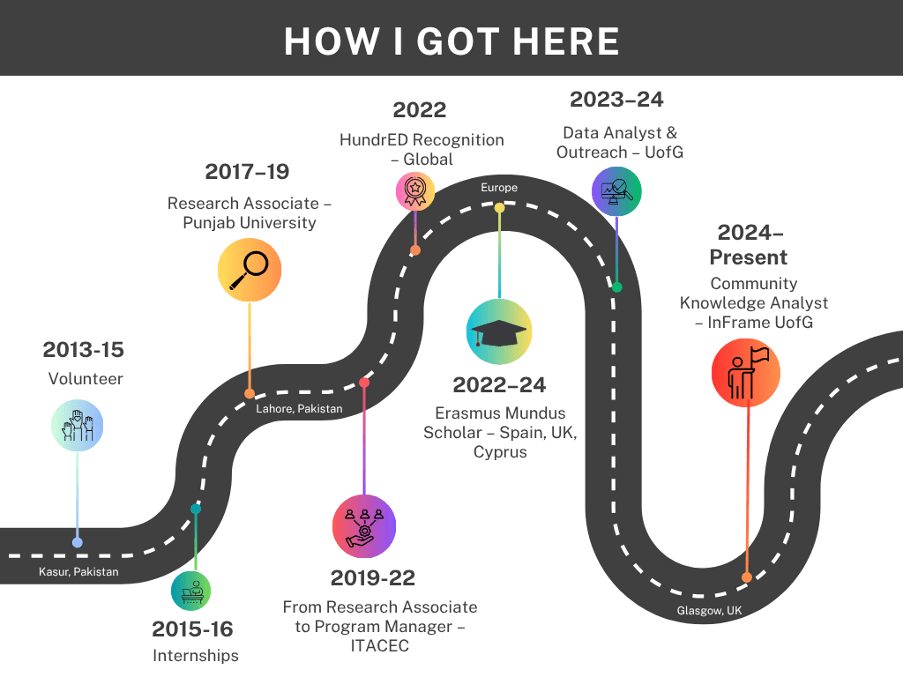
Transitioning from professional settings in the majority world to the Global North means navigating ambiguities, uncertainties, and challenges. Career progression is rarely a straight road. It demands efforts beyond just technical skills or academic credentials, a lesson I’ve learnt in my journey. I started off from a small town in Pakistan, then worked with high stakes international development projects, earned a scholarship in the Global North, and now work in a leadership development role in the UK’s higher education sector.
This journey meant more than crossing borders. It involved navigating different cultures, values, and expectations. Alongside the personal and professional growth that came with it, I had to learn to adapt to shifting systems—from immigration rules to unfamiliar work environments—while finding ways to hold onto my values and voice.
Still, what stayed with me wasn’t just the struggle—it was what I learned from showing up. In Pakistan, I had to learn on the go and lead large-scale education initiatives, collaborate with global organisations and build a network of supportive people. In the UK, I had to first understand, then participate in, and eventually take a leading role in shaping and enhancing research cultures. In between, I worked towards a two-year long rigorous multi-university Masters programme while being responsible for a young family that was accompanying me throughout. Each step taught me that progress depends not just on individual effort, but on the support and solidarity we build around us.
This commitment to inclusion and community now shapes my work with InFrame—a Wellcome funded project between the Universities of Glasgow, Edinburgh, and St Andrews to build a scalable, inclusive model for collegial research leadership—one that supports positive research cultures, expands leadership opportunities, challenge systemic barriers and build research environment where people feel seen, heard and supported.
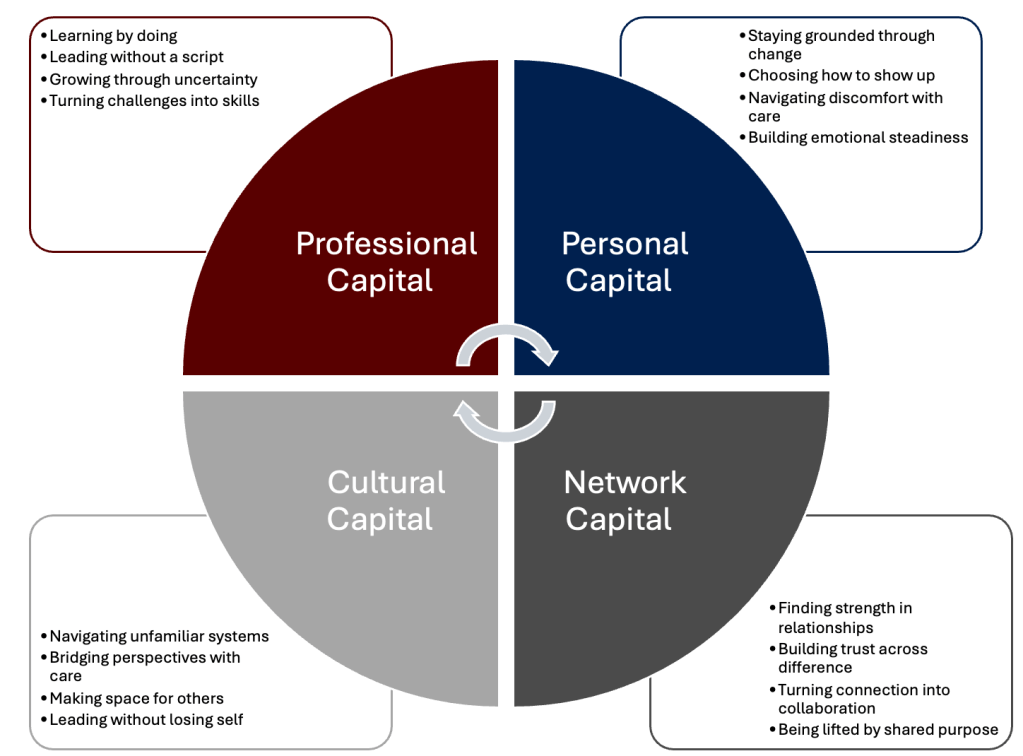
As I reflect on the pathway that led me to InFrame, my leadership role in research culture, and my journey so far, I can confidently say that it has been profoundly shaped by four key pillars that I’ve come to think of as forms of capital. When I say ‘capital’, I mean the resources, relationships, capacities, skills, and support systems we build over time—the things we draw on to move forward, and to grow, adapt, and lead across different contexts. For me, these have taken shape as: Professional Capital, Personal Capital, Network Capital, and Cultural Capital. I’m sharing these not just to reflect on my own path, but to invite you to consider yours. What forms of capital have helped you adapt, connect, or lead?
These four pillars, illustrated below with my own examples, might also offer you a useful lens to recognise what’s already supporting your growth, and where you might want to invest more intentionally as you move forward.
Professional Capital
The skills, knowledge, and values I’ve built by learning through action and reflecting on experience.
When I think about the skills I rely on now—in leadership, research, and collaboration—I don’t start with degrees or credentials. I think about the times when I didn’t have a roadmap but had to figure it out anyway.
My journey began in Pakistan, navigating university while stepping into the development sector. Early research projects and later, large-scale education programmes for marginalised communities taught me how to analyse data, lead teams, listen to community voices, and translate complex problems into workable solutions.
Later, working on national programmes deepened this learning. I had to hold onto my values while delivering at scale—whether writing policy briefs, bridging research and practice, or finding innovative ways to work across systems. Growth didn’t come from getting it all right. It came from trying, listening, and improving with each step.
Professional capital rarely develops in perfect conditions. It grows when we take on challenges, learn from mistakes, and stay curious. This pillar is built on those moments of learning-by-doing. And I offer it here as a reminder: showing up is a skill too.
Personal Capital
The inner work that helps me adapt, stay grounded, and grow through change.
Alongside technical skills, I had to invest in something less visible but equally essential: myself. Personal capital means building resilience, integrity, and emotional agility.
I’ve often felt like an outsider—adjusting to new systems, navigating countries, or facing visa restrictions and workplace biases. These moments weren’t just logistical—they were deeply personal. They taught me how to stay grounded when the ground kept shifting.
The GLOBED programme, where I first engaged with the University of Glasgow, was pivotal. It stretched my thinking, introduced me to new ways of working, and helped me learn how to transition between sectors and countries without losing my sense of self. I learned that adaptability isn’t just about coping—it’s about deciding how I want to show up in unfamiliar spaces.
This pillar is rooted in moments where I paused, reassessed, and chose a different way forward. It’s taught me that growth doesn’t always look like progress on paper. Sometimes, it looks like setting boundaries, asking better questions, or choosing rest over perfection.
Network Capital
The relationships that sustain me, challenge me, and help move ideas forward.
Almost everything meaningful in my career has happened through connection. Network Capital is less about who you know, and more about how the right relationships shape how you grow.
It started with small things—volunteering, helping organise events, joining conversations that felt slightly out of my depth. Through these early steps, I learned how much we can learn just by being in community with others. Over time, those connections deepened. I found mentors who challenged my thinking, peers who shared their knowledge generously, and collaborators who turned ideas into actions.
Conferences, workshops, and informal chats over coffee became spaces for listening across difference and co-creating knowledge. More than a path to professional advancement, these networks gave me solidarity—a sense that I wasn’t doing this alone.
This pillar reminds me that relationships are essential, not optional—they’re the foundation of a thriving research culture. And if you’ve ever wondered whether you belong in this space, sometimes the right relationships help you see that you do.
Cultural Capital
The ability to navigate difference and create space for others.
For me, Cultural Capital is less about knowing all the codes or fitting in everywhere, and more about learning how to listen across perspectives—and knowing when to push back with care. It’s what’s helped me find my footing when I felt out of place, and what now helps me make space for others to feel like they belong too.
As someone who moved from Global South to North, I’ve often worked in systems that weren’t built with me in mind. At times, I didn’t just feel like an outsider—I was one. But those experiences became strengths. I learned to decode new environments, find common ground, and build trust without losing myself.
This pillar also shapes how I lead—prompting me to ask whose voices are missing, whose norms are centred, and whose knowledge is valued. It’s why I advocate for inclusive spaces—not just diverse in who’s in the room, but in how power, knowledge, and participation are shared.
For anyone who’s ever had to adapt, shift, or code-switch, cultural capital might already be part of your toolkit. And if it is: it’s worth honouring. It’s not just survival—it’s leadership.
Each of these four pillars—professional, personal, network, and cultural—has helped me grow, make sense of uncertainty, and find purpose across different spaces. I don’t see them as fixed steps, but as a way to understand what’s enabled progress and belonging in my own path. I offer them not as a finished roadmap, but in the hope that they help you see something familiar in your own journey—a moment you figured something out, a connection that opened a door, or a value that quietly guided your choices. If you’re working out how to lead, to belong, or to build something meaningful—maybe some of this speaks to you. And if it does, perhaps it’s time we stopped seeing growth as a solo pursuit, and started shaping a culture that grows with and through each other.
 The Auditorium: a research culture and researcher development blog