
By Valerie McCutcheon and Matt Mahon, Research Information Management Team, Information Services
The University of Glasgow is strongly committed to open research practices which are a hallmark of an open, inclusive, and trusted research culture. One of the simplest ways that you can engage in open research practices is to apply open licences to your outputs.
Making your outputs (research, teaching, or professional practice) available with open licences enables you to share them widely and encourages reuse and citation. An output is not considered open access if it is simply made available on the internet with no licence; one of the key tenets of open access is that potential users should be able to understand how they are permitted to use an output and whether they need to seek permission for their intended use.
There are many benefits to open access. This diagram is a useful starting point.
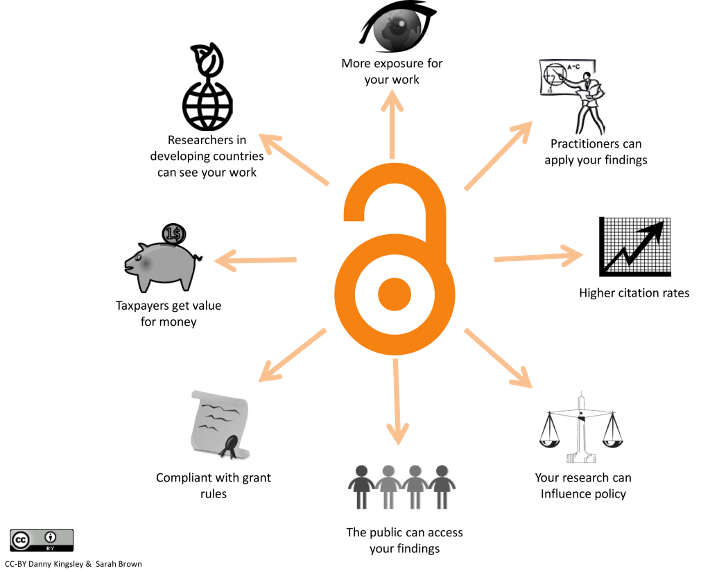
The University of Glasgow Code of Good Practice in Research clause 8.14 notes that researchers should consider open access options offered by potential publishers of their research, and how these align with the open access requirements of funder and research assessment exercises (e.g. Research Excellence Framework (REF) 2029). Staff and PGRs are encouraged to make their research outputs open access regardless of whether these result from funded research, or for part of a research assessment exercise.
It is important that authors consider licensing options before submitting their paper to a publisher.
In addition, certain major research funders require authors to make their research publications – articles and conference proceedings (and in some cases, books) – open access upon publication, and to be openly licensed under an Creative Commons Attribution licence (CC-BY*).
Many research funders also have an expectation that research data (and in some cases other research outputs) be made available for others to reuse with the least restrictive applicable licence.
The Research Excellence Framework 2029 exercise also has a requirement that articles and conference proceedings are given an open licence equivalent to the Creative Commons licences.
*What is a CC-BY licence?
Creative Commons are an international nonprofit organisation who provide a suite of open access licences. The most common Creative Commons licence is the Creative Commons Attribution 4.0 International (CC-BY) licence. This is a liberal licence that allows anyone with internet access to read and re-use the output as long as they acknowledge (attribute) the original authors.
The University of Glasgow recommends CC-BY as the default open access licence that authors should choose if there are no other restrictions to consider. Note however there may be costs associated with choosing a CC-BY licence and you should check if these can be covered before selecting this licence type. If you do think you need to use a different open access licence to CC-BY, there are many others you could consider, from the Creative Commons suite or elsewhere.
For example, major research funders including UKRI and Wellcome Trust will only permit more restrictive licences, such as CC-BY-ND, for publications in scope of their policy by exception. [Note, all the different terms such as ‘BY’ and ‘ND’ are explained on the Creative Commons webpages]. Creative Commons offer a tool to help authors choose licences: and there are suites of open-source licences specifically designed for code. Equally, IP owned by the Government which is made available open access is typically given an Open Government Licence.
How can you apply a licence your outputs?
The simplest way to license an output is to apply a licence at the point of publication. If an output is published by a third party, the publisher will apply a licence. For example, with a journal article or conference proceeding, the publisher will apply a licence to the version of record and may give the author permission to apply a different licence to the accepted manuscript. You should consider:
- Does the publisher offer a licence that complies with your institutional and funder policies?
- Is there a mandatory cost associated with the licence?
- Have you checked with the budget holder if this is an eligible cost (within the terms of your specific funding) or checked if the organisation has an open access arrangement with the publisher?
Paying for CC BY Licences
Publisher agreements sometimes cover the costs of open access publication for staff and students.
If you are funded by certain funders such as UK Research and Innovation, Wellcome Trust, Cancer Research UK, or the Chief Scientist Office there may be funds available to cover costs however there are restrictions, for example, UKRI and Wellcome Trust only allow their open access budget to be used where an article is in a fully open access journal and a CC-BY licence is chosen.
Each publisher and funder have specific criteria so please check with the open access team research-openaccess@glasgow.ac.uk to confirm the options available to you.
Rights Retention
At the University of Glasgow authors are encouraged to include a ‘rights retention statement’ in their initial submission to a publisher to comply with Glasgow’s Research Publications and Copyright Policy. This policy offers another option to authors that may enable their accepted manuscript to be shared with a CC-BY licence without incurring cost.
Outputs published in repositories
If an output is not being published by a third party (for example if you are sharing a dataset, code, grey literature or open educational resources), you will need to deposit it in an appropriate repository and choose an appropriate licence to apply.
The Dataset Licensing project produced a set of resources on choosing appropriate licences.
The Research Data Management team can help with finding appropriate repositories and understanding the options available for licensing datasets.
If you are in any doubt about which licence would be appropriate for your research output, whether it is code, dataset, protocol, or something else, you can start by contacting the Research Data Management team at research-datamanagement@glasgow.ac.uk.
For enquiries about open access for publications, please contact research-openaccess@glasgow.ac.uk.
 The Auditorium: a research culture and researcher development blog