
By Dr Joanna Royle, Researcher Development Manager
How do you eat an Elephant? As the cracker-joke quips: One bite at a time. Third space professionals (Whitchurch, 2008) – that is, those of us in universities who span professional services and academic scholarship – often find ourselves making change happen in exactly this way. We have the knowledge and experience to see the necessary direction of travel for our projects, but we have to actively navigate cultural and systems barriers to bring those projects to success. Rather being at the formal decision-making tables, we make change by knowing what to consider, where to push, who to connect with, and how to frame the conversation that sets things in motion.
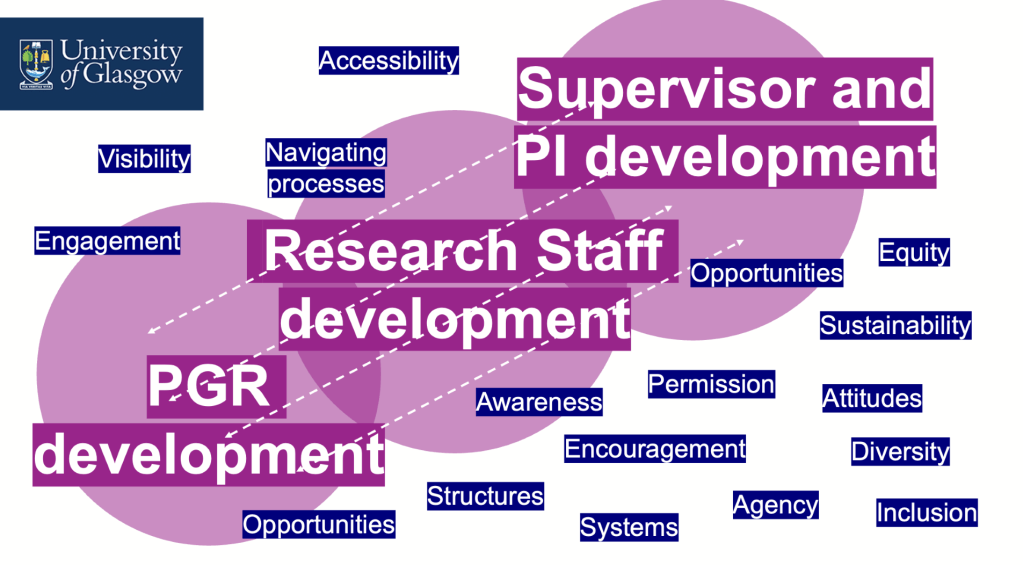
I’ve been thinking about this a lot recently: particularly about the incredible people across #TeamUofG that I get to collaborate with on a regular basis, and the kinds of positive changes we have managed to make together. Many are fellow research professionals, connected through Glasgow’s groundbreaking Research Professional Staff Network, but our team also bridge with folks across the full range of learning, information, careers, organisational, and academic development spaces. These collaborations aim to have a positive influence on the quality and quantity of development provision for researchers.
Of course, ‘influence’ isn’t a value-neutral word, but as I’m using it here, I mean the ways that we can be the go-to people with the expertise and collegiality to contribute productively and innovatively to making good things happen. Two diverse practical examples from my own work currently include working with the Transitions and Inductions Team to create ‘offer-holder’ resources for new PGRs, and with the Business Relationship Management Team in Information Services to support event management system procurement.
I’m certainly no expert in change-making or influencing (if you are looking for a more scholarly read, let me recommend this chapter by Donna Murray, 2022) but here are a few things that have helped me get things done. If you prefer listening to reading, you could skip right through the rest of this post and go straight to Sara McLusky’s Research Adjacent podcast (episode 65) where Orla Kelly and I recently chatted through these ideas.
Find your allies: you’re not alone
If you’ve noticed something could be better, the chances are someone else has noticed it too. They might even be working on a solution already, so you don’t have to start from scratch. For simply getting stuff done, assembling or joining informal cross-functional networks and short-life working groups can be just as, if not more, powerful than formal committees. Having allies who share your concerns isn’t just a source of support (though of course this is also important!), it is the best route to amplify a message and get everyone on the same page towards change.
Find your pathways: who needs to agree?
While there is a lot you can accomplish through horizontal networks, a great idea can still hit a wall if you don’t know where decision making happens. Get familiar with governance structures and oversight committees, how these operate at different institutional levels, who sits on them, what they are interested in, and who can get issues onto their agenda. Work out whether you really need to seek high-level senior leadership approval for a change, or whether you can pilot something locally, and escalate it later, once you have evaluated it successfully.
Evidence the need: what will motivate others to action?
And when it comes to evaluating a new initiative, make sure you are thinking about evidence that will have sway with key decision makers. HE is not short of good ideas, but in the current tightened budget climate, the ones that are most likely to fly are those that map to institutional and national strategic agendas: for example enhance student satisfaction or the research environment; or enable the University to respond to sector changes and opportunities. Feedback and impact metrics strengthen your case, as does evidence of successful initiatives at other institutions. You’re most likely to get buy-in if you can frame the change you want to make in a way that shows how it drives forward current priorities, and helps the institution stay ahead of the curve.
Work out what ‘else’ will be impacted
The main barrier that generates pushback on a good idea is inconvenience. If your change is going to add work, mess up someone else’s process, or tread on their toes, you will hit roadblocks. So, as you are building the coalition of the willing, also think about who or what else will be affected. Make sure you actively listen to all possible key players and aim for a win-win in your change design. This is true for small changes as well as big ones: you might simply be moving data from system A to system B, but if another team, remote from your process, has long relied on system A, you need to involve them in your planning.
Bring solutions: do your homework
We have all been in the position of asking people for input on how to solve a problem and getting tumbleweed in response. If you want your change to be proven to be desirable and accomplishable it is likely you who needs to be doing the legwork behind the scenes. Key players are more likely to say yes when they don’t have to do the heavy lifting, so do your due diligence on what will and won’t work and pre-empt objections – bearing in mind any needs for scalability, logistics, and resourcing. It helps a lot to be able to clearly state the end goal and different routes to get there. Better still, you can then put forward good reasons for your preferred route, making it easy for people to say yes. It is also worth remembering that unless you’re bringing in external funding, options with a phased approach or that can be embedded into existing initiatives are the most likely to be a go-er.
Know your funding options: where is the money?
Talking of funding, no matter how good your idea is, you are not going to get traction if there is no way to pay for it. Take a good hunt around for different financial options. This circles back to the first point about finding your allies: they may offer knowledge of internal funding streams or even have a budget line that can be leveraged. Get familiar with the annual financial cycles; the lead-in time for making resource asks; and crucially who controls the resources and how you can engage with them.
Bringing it all together
As a third space professional, of whatever job type or career stage, you have more power to make change than you perhaps realise. Yes, it requires patience, strategy, and the ability to reframe your ideas in ways that resonate with different players. Yes, it means learning to navigate the sometimes labyrinthine institutional structures: both their bureaucratic roles and their tacit dynamics. And yes, your first attempts won’t always pay off. But let me encourage you not to let fear of failure clips your wings. Find your people; find your pathways; and lay the groundwork by become known for your expertise, positivity, and collegiality. Put yourself in a position to be an advocate and take a bite of the elephant.
 The Auditorium: a research culture and researcher development blog