
Pathfinder Career Narratives is an ongoing series tracking the career choices and experiences of doctoral graduates. You can see all of the posts in the series here. You can find all the Pathfinder resources and opportunities here. Today’s blog is written by Dr William Haese-Hill, Research Software Engineer at the University of Glasgow. You can find Dr Haese-Hill on LinkedIn here.
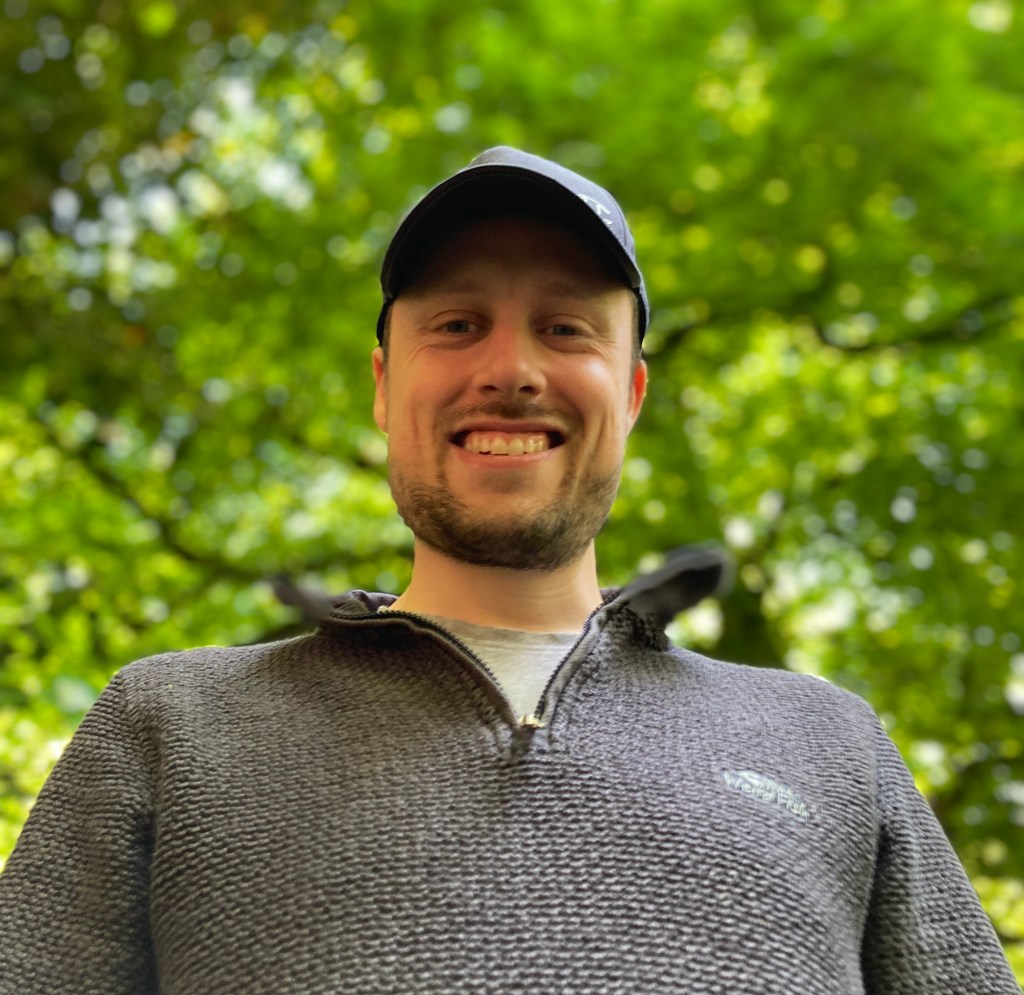
Name: Dr William Haese-Hill
Doctorate subject area, and year of completion: Mathematical Physics, 2015
Role and employer: Research Software Engineer, University of Glasgow
Approximate salary bracket of this type of role: Grade 7/8 on the University of Glasgow salary scale
I decided to pursue a doctorate in the wake of the global financial crisis of 2008. Going into my undergraduate Mathematics degree, I had naïvely assumed that simply securing a 2.1 would land me in a graduate program of my choosing, but this was all turned on its head. While I eventually obtained my coveted 2.1, fierce competition for PhD scholarships meant that I had to settle for a 50% grant to cover my living expenses, so I decided to throw myself into any and all opportunities for earning additional income while in program: teaching assistant roles, marking and invigilating exams, trials, and competitions.
On nearing completion of my PhD at Loughborough University, it became apparent that a role as an academic in Pure Mathematics wasn’t going to be feasible; my interests were aligned more closely with applied disciplines. So, in my final writing-up year, I secured a full-time job as a Mathematical Modeller at a small pharmaceutical contract research organization based on the university’s science park, a place for SMEs to interface with academia. Here I was introduced to programming for the first time (mostly basic scripting for data analysis), and realised I had a passion for it.
I spent the next 5 or so years in a variety of commercial software development roles around the UK, trying to expand my programming skillset. I had found myself growing quickly bored in each role I had in industry; once I had learned the ropes, the sense of challenge would plateau. By the last such role, I felt so demotivated that I even considered throwing in the towel altogether and retraining as something completely different. Around the time of the COVID-19 pandemic, when 100% remote working conditions were normalised, and having recently become a father for the first time, I started to crave a return to an academic environment, with its challenging scientific problems and collegiate culture. While living in Glasgow, I took my opportunity and applied for a fixed-term programmer position at a parasitology lab at UofG, relying on my first post-PhD life sciences job experience to bolster my application.
The next 3 years were some of the most fulfilling in my career to-date. I was given the opportunity to take ownership of several software tools, help to draft grant applications, and even get involved in teaching and paper authorship again. When a permanent role as a Research Software Engineer (RSE) for a core facility within MVLS emerged, I finally felt my career trajectory had a path for upward, rather than just lateral, growth.
Functioning as a core resource within the college, my current RSE role confers the variety and challenge of work that I have always craved throughout my career. I am able to juggle projects from schools throughout MVLS, covering such fields as neuroscience and cardiovascular science, while maintaining the network of connections I had made at the School of Infection and Immunity in my previous position. Our team are responsible for proposing and delivering modules for undergraduate or taught-postgraduate study, organising workshops in core software engineering skills to help researchers better develop themselves, as well as engaging with various committees and symposia to advertise our services.
For the first time in my career, I feel I have a great deal of autonomy to seek out collaboration opportunities across disciplines. While much of the commercial software engineering sector is firmly remote-working oriented, I value the opportunity to come to the Gilmorehill campus (a short cycle commute from my home) to work in a dedicated office and talk through problems with my team or researcher collaborators in person. Since the pandemic, I’ve found this separation of work and home life to be invaluable for my productivity and sense of purpose. While I still spend a lot of time coding day-to-day, I’m also relishing the variety of administrative duties and scope for leadership that comes with a more senior position, including mentorship opportunities.
On reflection, while I may not be using very much of the knowledge of Mathematical Physics that I accrued during my PhD, the general introduction it provided to academia has been invaluable in determining my eventual career trajectory; offering me a glimpse of the favourable working conditions that eventually pulled me back to the university setting. RSE jobs, which have only been in existence for a handful of years, let alone acknowledged as a viable career path, offer the opportunity to those who’ve been out of academia for a while to get back into a research focused role. My years of commercial experience combined with the research experience from the PhD have provided me a unique blend of skills that happen to fit well within my current position. I’m extremely fortunate to be pursuing my career at a time when such options are available. My advice to others: don’t be afraid to try a variety of roles before settling on something that works for you. There will always be opportunities arising in unexpected areas, and doors reopening that once might have seemed firmly shut.
 The Auditorium: a research culture and researcher development blog
One thought on “Pathfinder Career Narratives 60: Research Software Engineer”