
By Sasha Vaniev, PGR Development Events & Comms Intern 2023/24 (Sasha’s LinkedIn)
I am a 3rd-year international PhD student-parent in the School of Education. My PhD project explores the sociomaterial practices and (f)actors contributing to the teacher development of early career academics via the actor-network theory perspective. In a nutshell, I study what or who supports or limits PhD students and lecturers in their journeys to become competent university educators.
In this post, I will discuss the need for social circles in the PGR journey and where to look for them, and I share some of the lessons I’ve learnt from joining different social circles – within, outside, and beyond the School, University of Glasgow, and Glasgow city.
Where it all started
When I first arrived in Glasgow in 2017 to start my Master’s study in the School of Education, it felt like starting a new video game from Level 1. Upon my arrival, I knew zero people in Glasgow and was open to new connections I would make along the way. This included my flatmates, my course and programme mates, scholarship fellows, and new connections with people speaking the same language as me. Through various acquaintances in the university community, I found myself belonging to several social circles. This, retrospectively, enhanced my overall experience as an international PGT student in Glasgow and left me with long-lasting good feelings and impressions of my MSc studentship here.
On the other hand, when I returned from the UK to my home country and started my career as an educational specialist at a research-intensive institute, the picture was reversed. For a long time, I had a secluded glass-wall office to myself, but it was situated in the basement without anyone on my floor and without an online professional workspace like MS Teams or Slack. I felt quite isolated from the rest of my colleagues. I did not have a strong incentive to work on campus, and it was a lonely and, honestly, quite a sad experience that left me dissatisfied with this aspect of my work.
Returning to Glasgow in 2022 as a PGR felt different than it had in 2017, and I had to build my social circles again from the very start. I knew that the PGR journey was likely to be much more isolating than a PGT studentship due to the absence of group classes and coursework. Additionally, research done in arts, humanities, and social sciences is often a more solitary endeavour.
Before proceeding, note that I deliberately use the notion of a social circle above to highlight the close relationships and safety net aspects that I see as more versatile than notions of social group or social network.
Why are social circles essential?
As humans, we have fundamental needs for belonging and for connection (among other essential psychological human needs). We need people we can trust and rely upon – who can support and help us bounce back after a bad day. These needs become even more apparent for PGRs entering the academic world with its tendency to isolation (Janta et al, 2012) steep learning curves and challenging practices and conventions, that require shifts in our entire identity (Mantai, 2015, 2019; Mantai & Dowling, 2015).
Creating networks and safety nets is crucial not just for our well-being but for building social capital. This is especially true for international PGR students, who arrive in the host country and have to renew their social capital (Neri & Ville, 2008) due to unfamiliar cultural and educational institutions.
The social capital we build through the connections we make often open the doors to key people, tacit knowledge, job openings, and other prospects. Whether it’s a result of strategic networking or unexpectedly connecting with someone, these weak ties to our networks can be as powerful as strong relationships and can potentially translate into our valuable future opportunities. But where and how do researchers access these social circles?
Social circles and where to find them
Social circles can take various shapes and sizes and can be found in multiple spaces.
As researchers, we operate, work, and communicate within academic spaces which exist physically (campus buildings, classrooms, PGR shared spaces or conferences) and virtually (research group chat, professional workspace with colleagues, or an online reading group). PGRs navigate these spaces daily, and the social connections they make often shape their identity as researchers.
This means that the way academic or university spaces are organised ultimately affects who we become as researchers and the social capital we gain by the end of our PGR studies. In this scenario, the arrangement of physical spaces may facilitate (or impede) our interactions with others.
Academic-adjacent spaces, on the contrary, are more flexible spaces where students and research staff from across disciplines come together for events like seminars, professional development training, and social gatherings where they widen their social circles.
Non-academic spaces are even more informal, fluid and often based around shared interests, hobbies, housing arrangements, personal circumstances and backgrounds, and sociocultural connections offering shared languages, nationalities, ethnicities, histories, traditions, religions, or even cuisines! Quite often, sports- or arts-based activities provide great informal non-academic spaces. They bring people together, expand our social networks and broaden our PhD experiences. While they are not necessarily related to our research, they are connected to what makes us who we are.
In my case, I belong to several social circles that are ‘nested’ (McAlpine & Norton, 2006) but also intersect with each other within my PGR space and research group – like a matryoshka doll. I am part of a get-together chat, tea lovers’ meetings, ARC running buddies, and my research group’s open space.

Things to keep in mind
Enrolling in social circles sometimes feels easy, and sometimes takes courage, assertiveness, and mental effort. While much is written about the art and science of networking (check out this Auditorium blog post or this Times Higher Education long read), it’s rarely discussed what we should do after achieving that. I suggest:
1. Learn to find a balance.
There is always a balance between connecting, communicating, and socialising versus getting PhD things done. Balancing network building with productivity is a constant struggle, especially in shared open spaces. Working in an open-plan office sometimes feels like living in an episode of The Office. Some days, I spend joyful time with my colleagues but due to unexpected interruptions, I complete only a fraction of what I initially planned.
Using headphones, setting up a Pomodoro, attending writing retreats, or booking a meeting room for myself are just a few ways how I focus on tasks or my PhD writing.
2. Learn to say no and let things go
This lesson is best showcased by Hugh Kearns’ recent LinkedIn post:
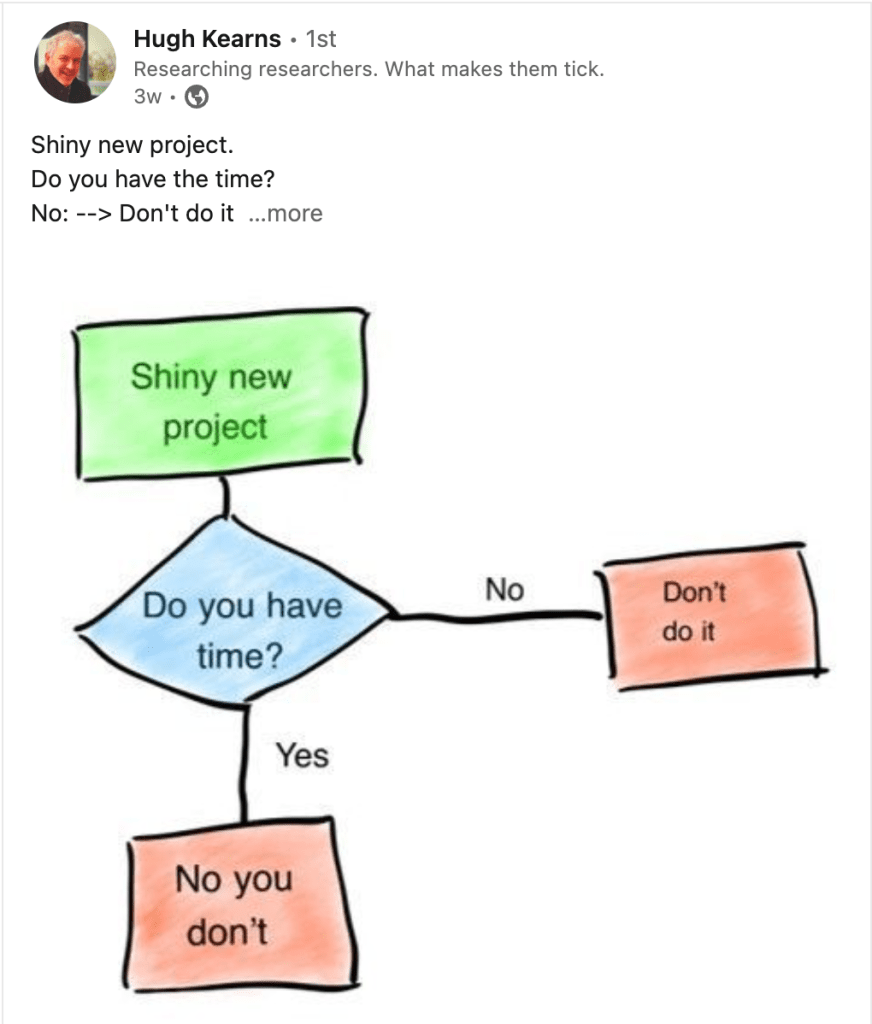
While building a safety net and enrolling in entangled social circles is essential for a sense of community and belonging, it’s important to know where and when to step aside or decline an opportunity. Once I was embedded in multiple social circles, it was hard for me to turn down invitations. However, it’s essential to learn how to say no to things, to politely and assertively decline offers, and not RSVP to every exciting event, project, or opportunity the world throws at you.
3. Avoid the false dichotomy of PhD work and socialisation
To quote my previous blog post: “PhD is part of life, and life is (an inherent) part of a PhD”. What I mean here is that the social circles that we build and join as PGRs, should not be seen as separate entities to navigate but rather as a valuable fusion for activating the tacit knowledge that one needs to access to succeed and make the most of the PhD journey, (the ‘Hidden Curriculum’) and also bringing much needed downtime (breaks, sports, social settings) to energise and fuel future academic endeavours.
Let me know your thoughts in the comments.
 The Auditorium: a research culture and researcher development blog
2 thoughts on “The value of social circles to the PGR journey”