
Pathfinder Career Narratives is an ongoing series tracking the career choices and experiences of doctoral graduates. You can see all of the posts in the series here. You can find all the Pathfinder resources and opportunities here. Today’s blog is written by Dr Eleanor MacPherson, Knowledge Exchange Lead at the University of Glasgow. You can find Dr MacPherson on LinkedIn.

Name: Eleanor MacPherson
Doctorate subject area and year of completion: Gender and Public Health, 2013
Role and employer: Knowledge Exchange Lead, College of Social Sciences, University of Glasgow
Approximate salary bracket for this type of role: £39,000-£44,000
The decision to change my career came at one of the most challenging moments in my life. I was recovering from cerebral malaria, a deadly form of malaria that can have life-altering impacts. Despite living in Southern Africa for a decade, I had never had malaria, and if I’m honest, I had become very blasé about the risks.
When I returned from camping in a highly endemic area, I spiked a fever, took one of the rapid tests I had at home for malaria—it was negative—and thought it was probably flu. As the days stretched on, the fevers and body aches became more frequent, eventually becoming delirious. If I look back at my arrogance, I have a PhD in gender and public health and have spent many hours in clinics conducting ethnographic research. I can’t believe my foolhardy behaviour. Very lucky for me, I was seen quickly at a private hospital in Blantyre, Malawi, hooked up to a drip with lifesaving medicine, and began the slow and painful recovery.
The one thing being bedbound gave me was time—time to reflect on the things that brought me joy. Since starting university in September 2001, I had always wanted to be an academic. If I wasn’t an academic, who was I, and crucially, where did I want to go next?
At the time, I was leading a team of social scientists based at the Malawi-Liverpool-Wellcome Programme, once of the UK medical charity Wellcome’s major overseas programmes. We were working on a range of interlinked and interdisciplinary research projects exploring antibiotic use practices. One of the best parts of my role was working with the team, and by far the hardest decision to leave was ending my working relationship with them. The project I enjoyed the most was working with the antimicrobial resistance coordinator in the Ministry of Health. Using participatory processes, we brought together affected communities and key stakeholders with the aim of sharing information to galvanise action and create local solutions to reduce the burden of antimicrobial resistance. This policy engagement sparked a joy in me.
If I take a step back, I have always loved to travel and at my heart, I’m a collector of stories, and love hearing people’s stories. I was extremely fortunate to begin my career in international development and then transition into global health academic research.
During my fifteen years working on a wide range of projects across West, East, and Southern Africa, I predominantly focused on interdisciplinary research projects on infectious diseases. I explored how people’s lives and livelihoods shaped their vulnerability to becoming sick and their responses to illness.
My work was always interdisciplinary, and I am a big believer in the power of working across disciplines when addressing societal challenges. I can trace this back to 2007, when I moved with my husband to South Africa and worked on HIV and gender project. I was based in a rural hospital; it was during the early roll-out of antiretroviral therapy. I worked with nurses, clinicians and gender trainers and saw up close the power of grassroots mobilising. From South Africa, we moved to Malawi where I combined working as a gender consultant with my PhD studies.
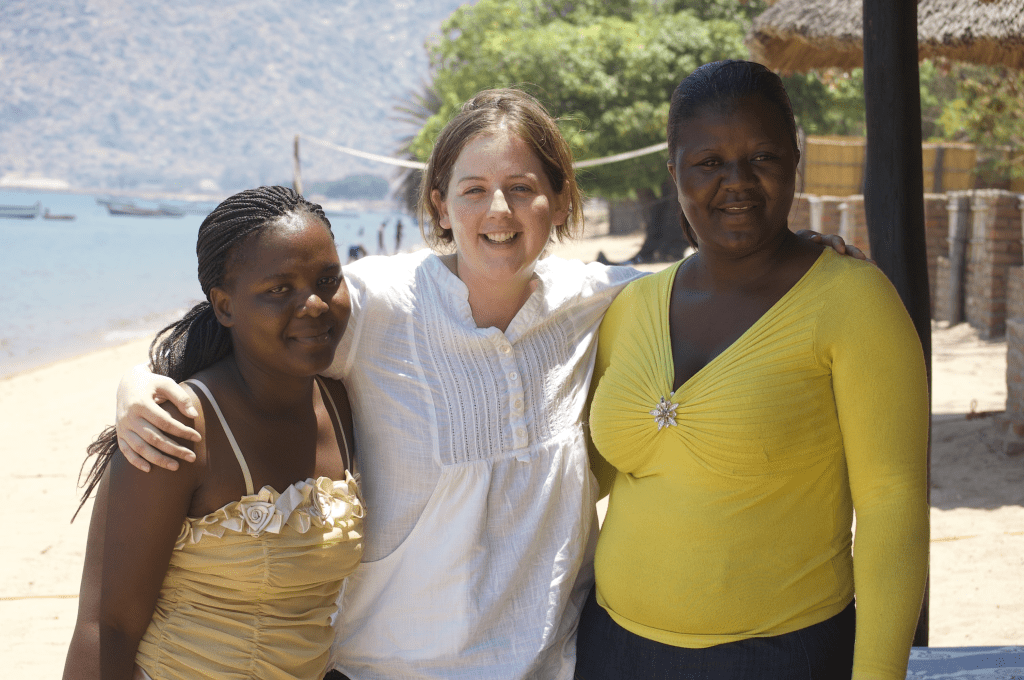
Eleanor with Victoria Nyongopa (right) and Alinafe Chimphonda (left) in Mangochi, Malawi during her doctoral research.
I had my son during my PhD and my daughter during my first post-doc, which means that my academic career has always been inextricably linked to motherhood. Trying to establish an academic career around motherhood with precarious research contracts was really challenging.
As the Knowledge Exchange Lead in the College of Social Science, I still feel like I am a collector of stories. Every day, I hear from academics conducting impactful social research, collaborating with non-academic partners to make a difference in society. In my role, I draw on the skills and training from my research career in three key areas. First, I deliver training on research impact, ensuring that academics understand how to engage with research users to ensure their work has societal impact. Second, I work one-on-one with academics to help plan their engagement and impact strategies, offering tailored support and guidance. Third, I support early research grant development, helping to shape proposals that have the potential to secure funding and drive innovation.
A critical aspect of my role is recognising and addressing power dynamics in our engagement work. Effective knowledge exchange requires a commitment to two-way dialogue, where all parties are heard, respected, and valued. This ensures that our collaborations are genuinely reciprocal and inclusive, fostering environments where diverse perspectives can thrive and contribute to meaningful change.
Having spent a decade working on research grants, I bring a lot of empathy to my role. I understand the pressures and challenges researchers face, and I use my extensive experience to provide practical and empathetic support. My training in social research methods, from participatory learning and action to evaluation, are invaluable skills that I apply daily, helping to embed continuous evaluation and improvement in my work. For me, this transition has been about taking a step back to effect change within the wider research ecosystem and finding joy in supporting other people and creating a positive environment. The transition has not only allowed me to leverage my extensive background in research but also, I hope, to foster growth and impact within the academic community.
 The Auditorium: a research culture and researcher development blog