
A doctoral researcher’s experience with the Bothy Project

Charlotte Slaymark completed her PhD in Earth Sciences part time. She recaps her creative solution to writing up after 7 years and working at the University of Glasgow.
Seven years of part time doctorate work but the end still felt so, so far away. Like a tiny island out at sea, it seemed unreachable with my current way of working. In 2022 a friend told me about Bothy Project and the artists residencies that happen at an off-grid bothy on the Isle of Eigg in the Inner Hebrides of Scotland. I checked out their website on a particularly despairing day writing up and saw an announcement about a ‘Fieldwork Residency’. The name pulled me in.
Is it for people working in STEM?
I work in the School of Geographical and Earth Sciences at the University of Glasgow as a research technician alongside doing my doctorate. My research focus is past climates and organic geochemistry. I use molecules preserved in geological archives to make records of past climate change at the end of the last ice age in the UK. Climate changed quickly then, and the environment responded rapidly too. It’s a fascinating time period to learn about how the climate system operates on ~100 to 1000 year time scales. I have done fieldwork in my research, so I kept reading the residency announcement. I had heard of residencies before but always related to creative practices, so I had no idea if this related to my research too. I researched environmental change in my doctorate work, so I thought I’d see if I might be considered for the ‘Fieldwork Residency’ opportunity.
I contacted Bothy Project to arrange a meeting. Fieldwork Residencies were a new strand for them, as they were keen to widen their work to include researchers and experts, ‘investigating landscape’ who are keen to share their work with the communities who live close to their bothies. The Bothy on the Isle of Eigg was secluded in the North of the island, without wifi or phone signal but expertly designed to create a work environment that cleared the mind and gave rise to focus. I needed to start a chapter of my thesis on the environmental change in central Scotland at the end of the last ice age and so I proposed I would work on this while on the residency in March 2023.
Public Engagement on the Isle of Eigg
As the first Fieldwork Resident, Bothy Project wanted to trial the format of the residency to include interaction with the island community. Bothy Project left me to think about how I’d like to share my work. I considered what my expertise is, what could I share, and with whom. It was challenging to come up with something without knowing my audience but Lucy Conway, Bothy Project’s host on Eigg, helped shape the format to suit the audience – with only 110 residents on Eigg, it’s good to get specifics. I decided to give a public talk on the very general area of my research and an outreach project I was planning. I chose this because I wanted to try out communicating research to the public in an informal way and see how my outreach project would be received.
I planned a 1hr-ish session on ‘Scotland under Ice’, that presented current research on glacial landforms in Scotland. We looked at interactive maps online while I provided explanations of how the land was formed, when and how to access these locations. I gave space for individuals to share what they knew. The physical format of the talk involved me sitting amongst the audience, on sofas in the Community Hall. We used the projector that would be used for the community cinema the next evening. I helped put the screen up with Lucy, the audience brought snacks, beers, tea and their dogs along. The informal seating arrangement stopped it feeling like a ‘public lecture’ and audience members could chime in at any point they felt like it. In the future I’ll endeavour to try this format out at other public events (or teaching situations!), not only because it helped me feel less nervous about positioning myself as an expert, but it facilitated discussion very well.
The public engagement event arose because of Bothy Project’s desire to develop the Fieldwork Residency strand with a view to the residents bringing knowledge to the communities’ around the bothies. It was also a wonderful way to meet people. Although planned for the start of the residency, the event had to happen at the end because of a round of illness in the community, so if future residents run an event, I’d recommend doing it early or mid-way through your visit. I learnt about taking care in the language I used, visual materials were best engaged with rather than text and the richest discussions came from audience questions.
My experience
As well as the opportunity for me to develop public engagement skills, I had gone to Eigg to write and renew some enthusiasm for my doctorate – it slips after 7 years! I benefited from the change of pace the residency provided. I wrote the draft of a chapter in two weeks because I finally got the time to sit down and focus on one task. This wasn’t possible when working on campus, where I had to manage technical requests and writing up. I went with this writing goal in mind and had to prepare a few things before heading off-grid. Although Eigg is well connected digitally, there is no Wi-Fi at the Bothy so I downloaded relevant papers and my datasets prior to arriving. This really helped me plan out the work I would do and helped keep my work-flow. There is Wi-Fi in the community spaces on Eigg so if I needed anything extra I could go to the library or café to download.
Little signal and no Wi-Fi at the Bothy also impacted my communication with life back home; the extra steps required to make a phone call were challenging at times.
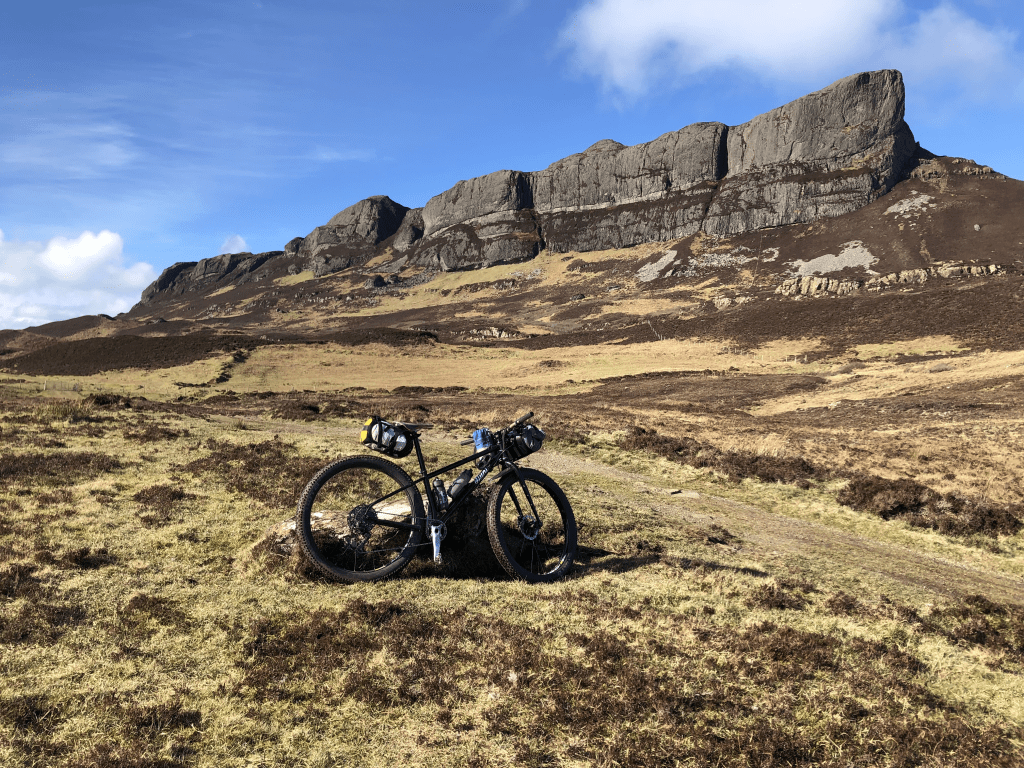
The best thing about working away was the ability to make my own schedule. I woke up early, worked until the mid-afternoon and got outside before the sunset. I anticipated working hours and hours a day because I thought I needed that and what else would I spend my time doing on a remote island? It turns out what I needed was quality hours, not quantity. When I had reached a goal for the day, I filled my time with reading by the fire or exploring the incredible landscapes of Eigg. I walked, cycled, and ran on the beaches and up the hills.
Each day I felt ready to work again because in the secluded place I learnt my working and living rhythm. I prefer this phrasing to work-life balance because rhythm is something that can change speed, but it can be continuous and once you find it, it can be repeated. I have carried this rhythm back to the city, despite having to work within a defined schedule again, I can repeat it in some form. I know my energy will run out for hard thinking by lunch time and exercise must happen every day for me to keep going.
I cannot help but be philosophical about my experience. I think Arts subjects have practices that greatly supports STEM work regarding personal development, motivation, and creativity. A Residency can be an opportunity to learn about yourself and the place you go to: go with an open mind to both and you could get a lot from the experience. I encourage STEM subjects to consider providing more opportunities to researchers to work and develop in this creative way. Writing retreats within your doctorate could be self- organised, to any location that inspires you (or a group). If you are looking to combine your research with public engagement work, consider responding to future Fieldwork Residency call outs from Bothy Project.
 The Auditorium: a research culture and researcher development blog