
Pathfinder Career Narratives is an ongoing series tracking the career choices and experiences of doctoral graduates. You can see all of the posts in the series here. You can find all the Pathfinder resources and opportunities here. Today’s blog is written by Dr Colin McIlroy, Curator of Modern Literary Manuscripts at the National Library of Scotland. You can find out more about some of Dr McIlroy’s recent work here.
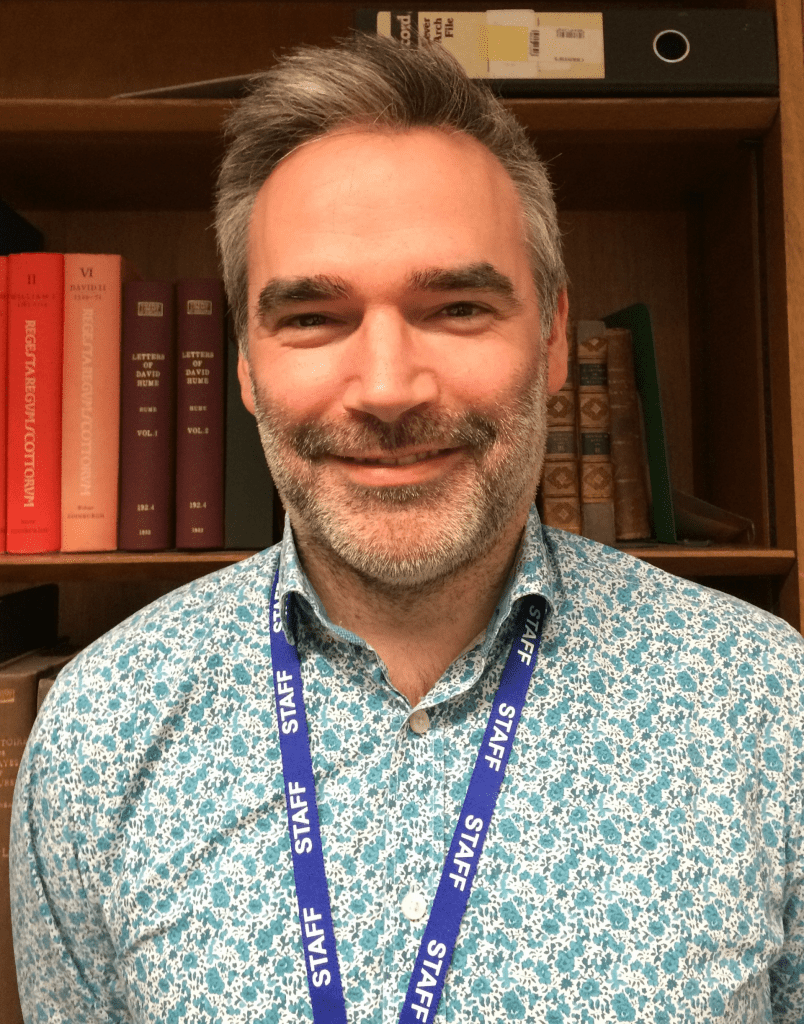
Name: Colin McIlroy
Doctorate subject area and year of completion: Scottish Literature, 2015
Role and employer: Curator of Modern Literary Manuscripts, National Library of Scotland
Approximate salary bracket for this type of role: £37,000 – £41,000 per annum
After the relief of finally submitting my PhD thesis in early 2015, I finally had time to consider what’s likely a familiar question to many of you, and one that had been easy to park at the back of my mind: what now? It’s not like I hadn’t thought about it during my Masters and PhD studies, but the absence of a parade and brass band to mark my submission day had reawakened me to the looming employment void I was now facing.
I began my joint undergrad in Scottish Literature / English Literature as a mature student and could hardly contain my enthusiasm at being granted the time to read novels, poetry, short stories, and drama by my favourite authors, and many that were new to me. This enthusiasm continued fairly unabated through my Masters, and as I secured funding for the PhD I thought, ‘great – now I have three years to figure out what to do next’. Three years later I woke up without any idea of what to do next.
By this point, pre-viva, but post writing-up and submission, I knew what I didn’t want, which was to (attempt to) become an academic. There were three main reasons. The first was that it took me far too long to complete anything, and the idea of having to demonstrate expertise across a range of subjects, authors, and categories of writers – as my lecturers, tutors, and academic supervisors all managed to do brilliantly – seemed beyond me.
Secondly, a lecturer in my undergraduate degree had been very kind following a presentation I’d given, and asked, unprompted, ‘have you thought about lecturing?’. I replied that ‘I’d love to!’ But after asking my age she said, ‘oh… they’d probably prefer someone younger’. 8 years had passed since this incident and in the interim, and despite my best efforts, I wasn’t any younger.
Finally, by the time I was sharing an office with other postgraduate arts students, it seemed that when a lecturing post came up, almost every single postgrad student I knew was applying.
So what did I hope to do? While attempting to solve that conundrum, amongst other things I applied for a post writing funding applications for a well-known nature conservation charity. Combining the writing, editing, and persuasive argument skills that my Scottish Literature postgraduate studies had given me with a love of wildlife seemed like an ideal amalgamation, but as with the other jobs I was applying for, they clearly didn’t agree.
Luckily my PhD supervisor, Professor Gerard Carruthers, asked me to do some research on his behalf, which involved around 3 weeks in the National Library of Scotland undertaking textual analysis of items in the archive of writer Muriel Spark. This wasn’t an official postdoctoral post, but it was much needed and very much appreciated work. Also, it came at the right time for me to re-engage with the subject of my postgrad studies (handily, the fiction of writer Muriel Spark), after the perhaps inevitable period of post-PhD weariness and the need to think about someone and something else.
Shortly after, Professor Carruthers alerted me to the newly advertised post of Muriel Spark Project Curator the National Library. The job would involve cataloguing and promoting the Spark archive in preparation for the planned centenary celebrations in 2018. I had a limited amount of archival experience from a previous job, but I didn’t think I was in with a realistic chance – especially after a friend suggested it would likely go to a qualified Librarian, or a candidate with Information Management qualifications, of which I had neither. However, what my friend couldn’t have known is that the Library placed emphasis on specific subject knowledge – in this case Muriel Spark – and that the training in archiving and cataloguing would be provided in-house by the Library. Thank goodness.
That’s the incredibly fortunate route I took to the National Library of Scotland. Other than sheer luck, all of this demonstrates the importance of building relationships with academic staff, as their knowledge goes beyond their subjects to include the wider cultural and employment landscape.
After 3 years at the Library, my manager retired and I secured her post as Curator of Modern Literary Manuscripts, and I’ve been in the role since.
So now I look after the archives of writers such as Robert Louis Stevenson, Muriel Spark, Alasdair Gray, Kathleen Jamie, James Kelman, George Mackay Brown, Nan Shepherd, Ian Rankin, and Naomi Mitchison, to name just a few. I’m also responsible for the archives of Scottish cultural bodies and theatre collections, such as the Edinburgh International Festival and Film Festival, the Traverse Theatre, and 7:84 Theatre Company.
The job involves acquiring archives and manuscripts either by purchase or donation, then processing, arranging, and listing the collections to make them available for consultation. I deal with enquiries relating to the archives, do my best to aid research into the collections, and undertake outreach and advocacy. Building good relations with writers, manuscripts dealers, agents, literary estates, and other archival institutions is crucial.
I give talks on certain writers and their archives, and welcome visiting groups to the Library to see material from the collections. Then there’s keeping a foot in the academic world through collaborative projects with academics, and when time permits, writing too.
I’ve been incredibly fortunate in that I managed to find a career in which not only do I get to utilise the skills of an arts postgrad, but also the specific subject knowledge, in my case modern Scottish literature. In this respect I’m not sure that there’s been much in the way of transferring skills, moreso a continuation of them. And the books and writers I was already reading now make up the contents of the archives it’s my job to care for. There is a significant amount of admin and the greatest challenge is time management and the juggling of competing priorities, but my postgrad studies prepared me for that too. I never considered becoming a curator or archivist, but that’s where I find myself, and I still can’t quite believe my luck.
 The Auditorium: a research culture and researcher development blog