
Pathfinder Career Narratives is an ongoing series tracking the career choices and experiences of doctoral graduates. You can see all of the posts in the series here. You can find all the Pathfinder resources and opportunities here. Today’s blog is written by Doris Ruth Eikhof, Professor of Cultural Economy & Policy and Director of Arts Lab at the University of Glasgow. You can find Professor Eikhof on LinkedIn here, and at the University of Glasgow webpage here.
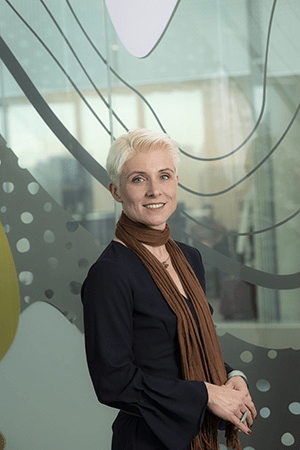
Name: Professor Doris Ruth Eikhof
Doctorate subject area, and year of completion: Management Studies, 2011
Role and employer: Professor of Cultural Economy & Policy, University of Glasgow
Approximate salary bracket of this type of role: £63,000 upwards dependent on zoning.
My career was decided by a hypothetical beehive. To help me choose between law and business studies I went to taster lectures. The law lecture discussed if a bee colony took possession of an unoccupied hive, who owned the colony? On the business studies timetable was macroeconomics which explained in a few neat diagrams the impact of fiscal policy on the labour market. In my defence, far more educated people than Suburban Kid Me have been mesmerised by the simplistic beauty of economic modelling (some never grow out of it). But yes, youthful boredom in the face of hypothetical bees tipped the scales in favour of business studies.
Studying business in Germany meant a 5-year degree, equally split between five subjects. Business and economics were compulsory. I was working part-time as a HR officer on a ThyssenKrupp shipyard and enjoyed the combination of people and processes, so I went with human resource management (HRM), sociology and business law (bee-free) for the other three subjects. I finally dumped economics (beautiful but also somewhat lofty and limited) for social theory (charmingly complex, contradictory, messy, real, with a touch of French). Graduating from the University of Hamburg I had three options: HR trainee on the shipyard, lecturer-cum-PhD position in Economic Analysis of the Law, lecturer-cum-PhD position in HRM & Organisation Theory. I went with #3. I would like to recall a systematic weighing up of options but to be honest, I think I simply felt most at home when reading, writing (words, not equations) and conversing in coffee shops and seminar rooms. Plus ça change.
I have explained this academic upbringing because it marked the compass by which I have navigated my career ever since:
- An appreciation of different forms of knowledge.
- Curiosity about people’s experiences, and the processes and structures in which they unfold.
- An interest in producing new knowledge.
- Wanting to use that knowledge to shape processes and structures so that people can have better experiences.
I wouldn’t claim to have started out with this compass, but it became an increasingly conscious tool for pathfinding (see what did there?) and career decision making.
My PhD research looked at careers in German theatre. Initially theatre was meant to be a case study of how entrepreneurship of the self and precarious employment might develop generally. But cultural economy research quickly became my thing in its own right: studying how individual motivation, creative passion and work experiences interact with arts & culture organisations, creative industries business models and cultural policy. I started to work with industry and policy on how to improve things, especially once I realised how much there was to do on diversity and inclusion (D&I). My first D&I paper, ‘You don’t have to be white, male and middle-class to work here, but it helps’, looked at the structures that create inequality – and that’s what my research, knowledge exchange, policy and advisory work have focused on ever since.
In 2008 I moved to the University of Stirling. Personal reasons had combined with professional opportunity: in the UK, creative industries, and research that sought to understand and shape them, were much more ‘a thing’ than in Germany. I kept teaching HRM and general business studies but found, spread across the UK, an emerging community of likeminded researchers. The creative industries had become a focus of UK economic policy, and funding opportunities, especially for working with arts & culture rather than studying them, started to emerge. Which suited my preferred mode of creating and applying knowledge perfectly.
At Stirling I was also PhD convenor and research convenor. I became interested in research environments and infrastructures, in how we produce good quality new knowledge and in how our knowledge lives in the world beyond our campuses – and in how all that intersects with the weekly workloads of academics and the peculiar rhythms of the academic year. And with the equally peculiar processes of institutional support for research, knowledge exchange, innovation and suchlike.
In 2014 our family headquarters moved to the Midlands. I took up a Senior Lectureship in Work & Employment at the University of Leicester and soon became Co-Head of the Management School’s Work & Employment Group. I don’t have particularly fond memories of the A3-printed Excel tables I spread across the kitchen table (and floor) to work out the workload allocations for our innumerable on-campus and distance learning modules. But this task was easier to combine with being a primary carer just out of maternity leave than endless on-campus meetings, so I consciously accepted Excel Central in return for working flexibly.
When the University of Leicester announced a competition for research institutes (modelled on the ESRC Centres back then), Mark Banks, professor in the School of Media, Culture & Sociology, and I won a five-year award for the multi-disciplinary CAMEo Research Institute for Cultural and Media Economies. We had to design CAMEo from scratch – not just the programme of research, impact and engagement activities but also the posts, budgets, KPIs, relationships within the University structure, branding, everything. Developing CAMEo with a team of soon 10 people was full-on and hugely enjoyable, and, fortunately, also successful. I got to do the D&I-focused research, engagement and knowledge exchange I was passionate about in a purpose-built setting. Pretty perfect.
But then the University of Glasgow recruited professors for the School of Culture & Creative Arts, a difficult-to-ignore professional opportunity even if it hadn’t been back in my adopted hometown. In June 2020 I started at UofG – and because of COVID lockdowns didn’t set foot on campus (or into the city) for months. It wasn’t until I moved into the Advanced Research Centre in summer 2022 that I could finally ship and unpack my boxes from Leicester. My research collaborators were spread all over the UK, Australia, Germany and Canada anyway, so I was used to working remotely. But finding one’s feet in a university community as complex as UofG’s solely online first and then slowly via the odd social coffee was something entirely different.
At some point amongst the endless Zooms I became first Acting Director and, in 2023, Director of Arts Lab. I now teach and research half of my time, and spend the other half leading a small team that develops the College of Arts & Humanities’ research infrastructure and supports colleagues in building research programmes, collaborations and careers. I work with individual researchers on their projects and with a range of brilliant academic and professional colleagues on research policies, processes and initiatives. My own focus is on inclusion, drawing on what I have learned – and continue to learn – working with and for the UK creative industries. I guess a grown-up summary of my role would be “building a research environment in which we value difference and enjoy inclusive practice as a default of producing and disseminating knowledge.” But a policy maker once gave my work the strapline “Behaving less sh*t, one day at a time”, and tbh, that’s just as accurate.
I honestly don’t know how much use any of the above is for someone else – it’s very much my story and what’s worked for me may well not work for someone else. The one learning that may be worth sharing is that institutional research management and leadership roles are often misunderstood as mere extensions of an academic’s personal research. Which is neither true nor helpful. These roles require specialist knowledge and an ability to work swiftly across ever-changing contexts inside and outwith one’s institution. A lot of the time they will have nothing to do with your own research. I find this work interesting and rewarding – good trouble, if you wish. But if you’re interested in that kind of career path, it’s probably a decision best made knowing a little of what you’re letting yourself in for.
 The Auditorium: a research culture and researcher development blog