
Pathfinder Career Narratives is an ongoing series tracking the career choices and experiences of doctoral graduates. You can see all of the posts in the series here. You can find all of the Pathfinder resources and opportunities here. Today’s blogpost is written by Dr Dickon Copsey, College Employability Officer in the College of Social Sciences at the University of Glasgow. You can find Dr Copsey on LinkedIn here, and find out more about his work in the College of Social Sciences here.
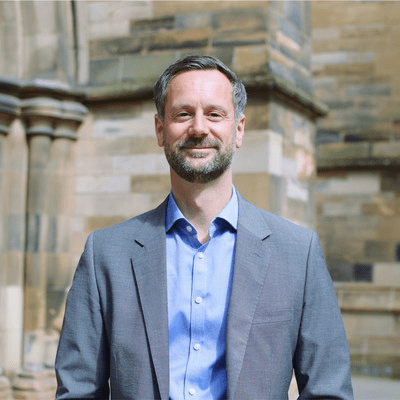
Name: Dr Dickon Copsey
Doctorate subject area and year of completion: German Studies, 2002
Role and employer: College of Social Sciences Employability Officer, University of Glasgow
Approximate salary bracket of this type of role: £48-56,000 per annum
The story so far…
You don’t often get a chance to step back and reflect on where you are and how you got there. So it is nice to share a few thoughts on my journey so far from a PhD studentship to a professional services role in student support. The fact that I started out researching German comedy cinema (always gets a laugh!) and have ended up delivering professional development support services to university students may not seem like the most common post-doctoral career pathway. In fact, if any career journey demonstrates that there is no such thing as a ‘typical’ career path then it is probably mine!
So, the first lesson I would draw from my own experience would be – don’t worry if your career path is neither straight nor teleological. In my experience, careers rarely are!
Despite my slightly meandering path through the five professional services roles I have occupied in Higher Education since my PhD, I think there have been some common characteristics shared by them all – characteristics that have probably guided my career from the start. The first characteristic of my roles to date is that they are all about helping people – specifically, helping people with their personal and professional development. The second is that they are all largely practical and operational roles.
When I finished my PhD in the early 2000s, the one thing that I did know for sure was that I wasn’t massively motivated to become the world expert on German comedy cinema (there, I told you it would get a laugh!). That is not to say I didn’t enjoy my PhD. In fact, I really loved my 4 years of reading, thinking, learning (and even occasionally writing!). My supervisor – Prof Alison Phipps – was simply amazing. She was massively supportive, caring, a great mentor and extremely inspirational – so thank you very much, Alison! And yet, despite this, I knew at the end of the PhD process that I wanted to do something more practical with my energies. If I am honest, I always loved the teaching that I did alongside my PhD as much if not more than the PhD itself. In particular, I loved the energy you got from working with learners and helping them to develop new skills and understanding. It is perhaps not then so surprising that this is what I went on to focus on.
So, lesson number two for me would be to be honest with yourself about what actually energises you. If you find yourself heavily drained after a day of reading and writing, but totally energised after a day’s teaching, then maybe the research pathway isn’t for you.
Making the transition… – From academia to student support
Alongside my PhD, I had been tutoring on a widening access programme called the Top-Up Programme. This involved working in a team to deliver HE preparation programmes in secondary schools. Doing Top-Up helped me realise how much I enjoyed working with learners, how much I needed to do something I felt was worthwhile, and how much I loved the teaching and facilitation process itself. This part-time role alongside my PhD really helped me to develop the facilitation and communication skills that I would draw on for the rest of my career.
I did apply for a few academic jobs at the end of my PhD, but I wasn’t successful and, looking back, I realise my heart wasn’t really in it. Then, when a full-time administrator’s job came up at the Top-Up Programme office, I immediately realised I needed to apply; and as I started to put together the application, I realised how much more I had to say about this role as opposed to the research roles I had applied to previously. I am also fairly certain that this energy and passion would have communicated itself in the application and interview process. Never underestimate the value of truly wanting a job when you apply for it!
As luck would have it, I secured this role and went on to become Deputy Head of the Programme before moving on to a role supporting Further Education to HE transitions, and finally a role supporting care leavers into university. From there I moved into my current role in student support and employability.
It is important to note that the initial job I secured was administrative and probably below the starting salary a PhD graduate might expect to command. I was so keen to make a transition into something more practical and personally meaningful that neither of these aspects bothered me. In retrospect, it was exactly the right move for me, and my subsequent career journey was possibly accelerated as a result of my PhD.
So, lesson number three for me would be don’t worry too much about the starting point or salary (as long as it pays the bills). In my experience students with previous postgraduate and professional experience tend to advance more quickly in their careers whatever the starting point. For me, it was always far more important that I was motivated by what I was doing than where I started.
I did slightly dread explaining to family, friends, fellow PhDs and my supervisor that I was leaving academia but in reality this was not an issue at all. Without exception they were entirely supportive and could see how motivated I was to pursue this new career path.
A week in the life of…
So, what does my typical week look like? It is a cliché to say that no week looks the same, but this is certainly true for the more senior student support roles available in HE. Typically, you have an extremely broad remit and an extremely large number of students to support, so how you tackle the job takes imagination and creativity. My role requires me to identify the problems facing students in terms of their personal and professional development and then to either develop projects to meet these needs or to harness existing university services who can support them. This could involve developing new skills courses, integrating more work-related learning activities into the curriculum or even commissioning support from university services or third-party suppliers. One of the most interesting aspects of the job for me is that pretty much all of the tasks and projects that I have to complete on a daily basis were instigated by me. (So I can’t really complain about being stressed as it is usually me that has put me under the stress in the first place!)
So, lesson number four for me would be do consider the vast array of jobs that are available with the HE sector in student support and which often offer vast amounts of autonomy and opportunities for creative thinking – attributes that PhD students have had to develop to survive. These roles also often offer the space for teaching and facilitation – again skills that PhD students tend to have developed during their studies.
Final thoughts…
A bit like the romantic myth, the first thing we need to accept is that there isn’t just one job out there for you. There are many, many roles that could fulfil your needs, interests and passions. The question for postgraduate researchers is, firstly, where do you start and, secondly, where do your needs, interests and passions really lie? Research and teaching careers offer fantastic opportunities for post-doctoral graduates energised by the research process. But for those who aren’t so invested and energised by research – don’t worry! You have developed a wide array of extremely transferable skills and there are a multitude of exciting opportunities out for there for you, not least in student support.
 The Auditorium: a research culture and researcher development blog