
Linsey Ip, Administrative Assistant, Public Health in the School of Health and Wellbeing, discusses the value of reflection and experiential learning in mentoring

The Athena Swan Charter is a framework used worldwide to support and transform gender equality within higher education and research. In June 2023, the UofG School of Health and Wellbeing (SHW) celebrated renewal of our Athena Swan Gold award, reflecting the efforts that our school’s community has made to ensure we have an inclusive place to work and study, not only with regard to gender equality but also more broadly.
The Athena Swan Mentoring Working Group was established alongside nine other working groups to deliver equality and diversity activities in SHW, guided by our Athena Swan Self Assessment Team. The initial goal of our working group was to set up a mentoring scheme in line with the existing examples of good practice from institutions/departments with Athena Swan gold awards. Initially there was a focus on gender equality and ensuring that this was considered within the mentoring scheme, however, the scheme evolved and, whilst we aim to build upon the progress already achieved with regards to gender equality, we recognise this is not the only potential source of inequality.
Why Mentoring?
Mentoring allows our school’s community to learn and grow together, sharing experiences and knowledge. It encourages inclusion and diversity in the workplace and is an effective tool in our school’s efforts to create an inclusive and supportive workplace culture.
Our working group members are drawn from across all SHW research groups and include academic and professional services staff, and a post graduate researcher. We work closely with SHW’s professional services and early career researcher working groups. Our scheme aims to improve career development for all staff and postgraduate researchers within the school, assisting mentees to make the best decisions for their future and to aid the mentee’s growth and skills development.
We encourage staff members to consider mentorship, building this conversation into annual Performance and Development Reviews. We also use this opportunity to recruit both mentors and mentees to the scheme.
We recognise mentoring is a skilled practice and encourage all of our mentors to undergo training. Earlier this year we asked our UofG colleagues, Dr Elaine Gourlay, Research Culture Specialist (Communities and Collegiality) and Dr Kay Guccione, Head of Research Culture & Researcher Development, to deliver a workshop, ‘Making mentoring work for you’ and they kindly accepted.
The Workshop
In a relaxed and confidential space, our group explored what mentoring is. We provided them with a non-judgemental platform to reflect and explore ideas in relation to our mentoring scheme. Importantly, we learned the value of focussing on the mentee as a whole person, not just focussing on their careers. Through group discussion, we could see that a holistic approach could result in better outcomes from a mentoring relationship.
We considered the value of adopting a learning tool to our mentoring practices, such as Kolb’s experiential learning cycle; a continuous cycle of experiencing, evaluating, learning and planning.
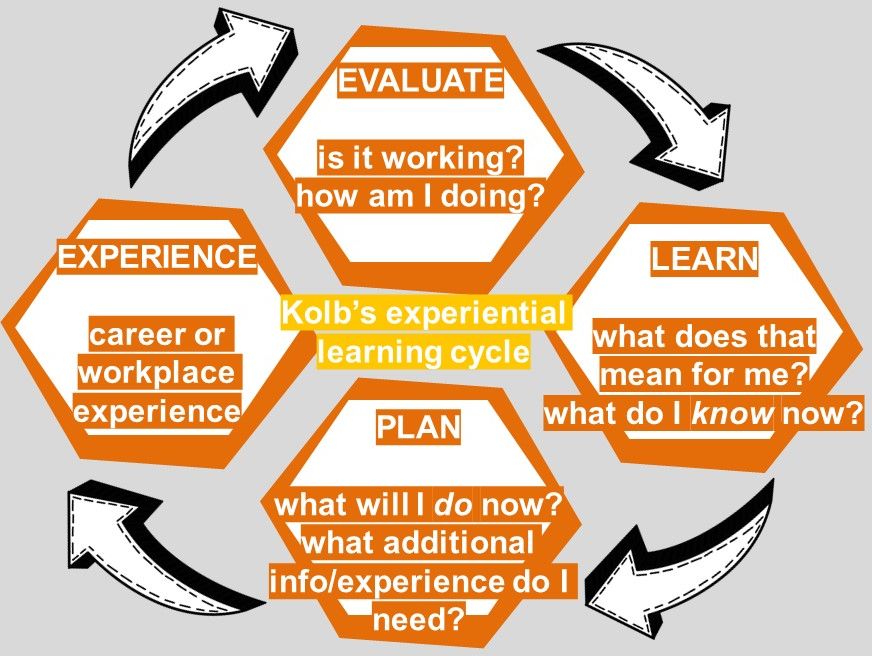
Using a simple exercise – in our case a short practice conversation that asked us to avoid offering the mentee advice – we had the opportunity to progress through the stages of the cycle.
After the experience of the exercise, we evaluated how it felt to engage in mentoring without offering advice, it’s harder than you might think! It was evident that whilst there are advantages of providing advice, there are also many disadvantages that would not be conducive to a successful mentoring relationship.
We learned – it was clear that a mentor with a range of skills will serve mentees better than one who relies solely on advice. A mentor that listens, questions, guides, or challenges, for example, can help the mentee to grow and learn, encouraging them to find their own way through reflection. It can also be liberating to know that as a mentor, you do not need to know all of the answers, all of the time!
We planned for moving forward with new and existing mentoring relationships noting that the methods deployed in a mentoring relationship should be based on the mentee’s goals. A mentoring agreement is a useful tool for discussing and agreeing expectations and goals. It provides a framework for the relationship, which is a key element for success.
This exercise proved valuable. Our group members left the workshop equipped with the tools and fresh knowledge to develop their mentoring relationships, ready to move on to the second loop of their learning cycles with confidence.
We extend sincere thanks to Elaine and Kay for supporting the Athena Swan Mentoring Group’s efforts to create an inclusive and supportive workplace for the staff and students of the School of Health and Wellbeing.
 The Auditorium: a research culture and researcher development blog