
By Dr Neil McIntyre – Knowledge Exchange Associate, Dr Lindsay Middleton – Knowledge Exchange Associate, and Dr Fraser Rowan – Knowledge Exchange & Innovation Manager, all in the College of Arts at the University of Glasgow; and Dr Michael Pierre Johnson, Creative Economy Leadership Fellow in the Innovation School at The Glasgow School of Art.
The past fifteen years have seen significant change in the UK research landscape. From the evolution of the Research Assessment Exercise (RAE) into the Research Excellence Framework (REF), to the first assessment of ‘research impact’ in 2014, knowledge exchange (KE) and impact have become familiar concepts in the UK research lexicon.
As a result, there has been a shift in thinking about research, interdisciplinarity, project development, and partnership. Now more than ever, there is both a desire from and pressure on academic researchers to engage colleagues across disciplines and in organisations external to the Higher Education (HE) sector, including diverse communities and publics.
For many Higher Education Institutions (HEIs), internal structures are fundamentally changing to reflect this, with increasing investment in research and impact support, innovation, and public engagement. As the recent REF 2028 announcement has confirmed that impact will retain a 25 per cent weighting in the assessment and research culture and environment will increase from 15 to 25 per cent, such proportional change is likely to continue.
The challenge of Knowledge Exchange
When pursuing KE and potential research impact, there has been a tendency for approaches to partnership and project development to be academic-led and driven primarily by academic curiosity (Fig. 1). This is understandable and not necessarily problematic – and no doubt it can be successful – but it can create unforeseen problems relating to issues of responsibility and sustainability.

For example, a lack of awareness, resource, planning, or support can lead to KE and impact being ‘bolted on’ to projects rather than built in at their inception, leading to potentially negative implications for partners and stakeholders. There is, indeed, a widely held concern beyond the academy of researchers having to ‘drop in and out’ on account of the lifecycle of their projects.
At the same time, there is the issue of accessibility. People of all backgrounds are eager to connect with researchers, but are often unsure how to reach them, access research, and engage HEIs.
The challenges do, however, present opportunities. Embracing collaborative working across HE, and with a wide range of communities, can help solve the problems that we face collectively in a way that is difficult to achieve alone.
In recent years, these issues of responsibility, sustainability, and accessibility have raised serious questions and prompt a need to rethink approaches to KE. To truly understand how knowledge co-production can impact communities or particular socio-cultural contexts, there has been a growing awareness of the need to consider explicitly the power relationships between partners in research and project development.
The College of Arts Partnership Catalyst
In line with these changes, the University of Glasgow College of Arts Partnership Catalyst was devised. It is a design-led and partner-driven KE programme in collaboration with the Innovation School at The Glasgow School of Art and funded by the College’s Arts and Humanities Research Council Impact Acceleration Account.
It reverses academic-focused approaches to partnership and project development by centring sector, partner, audience, and community needs (Fig. 2).
The Catalyst invites partners to identify cross-sectoral challenges and opportunities on a specific theme to catalyse the co-creation of solutions that might be addressed by Arts and Humanities research. This ensures that KE is being driven by the needs of partners and stakeholders.
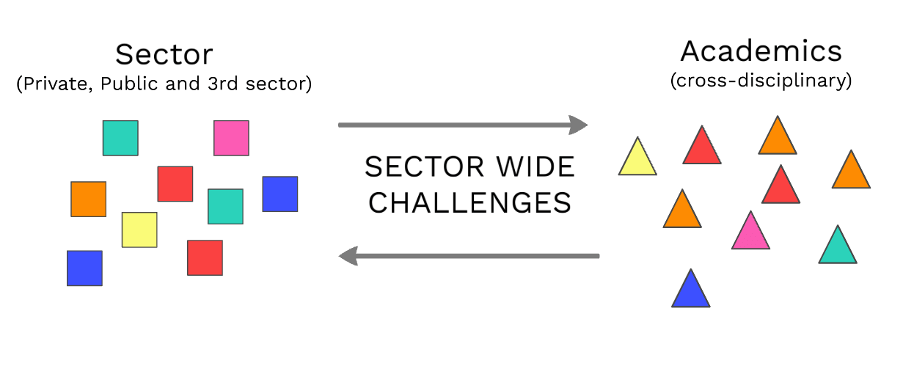
The model has been conceptualised to avoid top-down approaches to KE, and it accounts for differences in scale and access to resources. This overcomes the risk that KE becomes something that is simply ‘done’ to people, organisations, or communities. Academic and sectoral partners are brought together on a level playing field with equal consideration given to their knowledge, experience, and expertise.
Design as a discipline has evolved from a problem-solving profession towards a sense-making capability and a practice that produces insight to shape new services, experiences, systems, and policies. Design-led Innovation foregrounds the use of bespoke and flexible participatory methods, including sketching, mapping, modelling tasks, prototyping, and design games. These methods are used to engage people, communities, and other disciplines, build upon their reflections and ideas, and envisage new ways of living and working.
Design-led Innovation is critical to the Partnership Catalyst. This is what makes it unique, when combined with its supportive infrastructure. Deploying these innovative tools and processes has helped us remove barriers to participation, identify challenges, and devise objectives towards the development of research solutions and projects.
Challenges are explored initially using a form of network mapping that we have presented as ‘Innovation Maps’ (Fig. 3). Data is generated from participants discussing and sharing their insights and experiences, and an ecosystem is synthesised from the initial catalysing challenges. Pathways are then co-constructed, which generate proposals for addressing sectoral challenges.
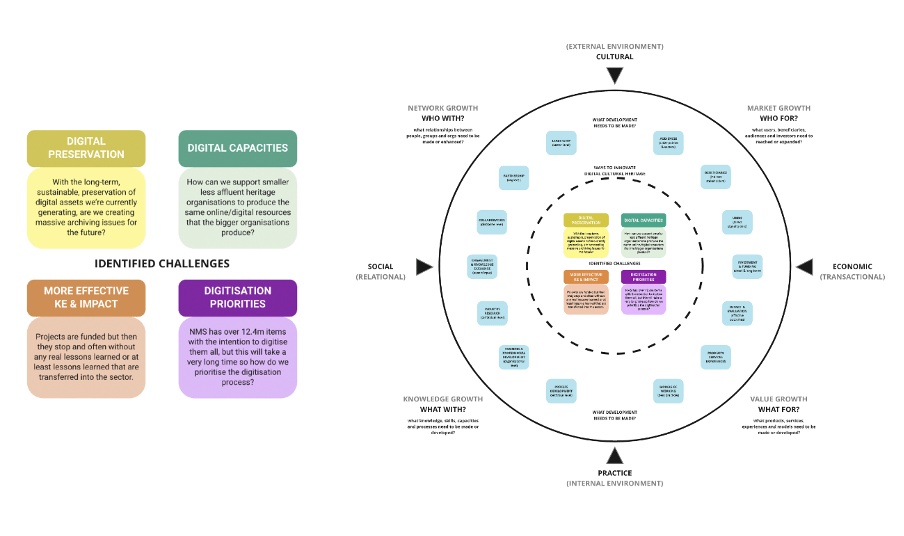
Catalyst is an iterative process that we have been piloting for one year on the themes of Digital Cultural Heritage (Fig. 4) and Food: Sustainability, Health, Heritage and Tourism (Fig. 5). Discrete projects have and continue to emerge from these themes. The third Catalyst, on Mental Health & Wellbeing, will launch this summer.
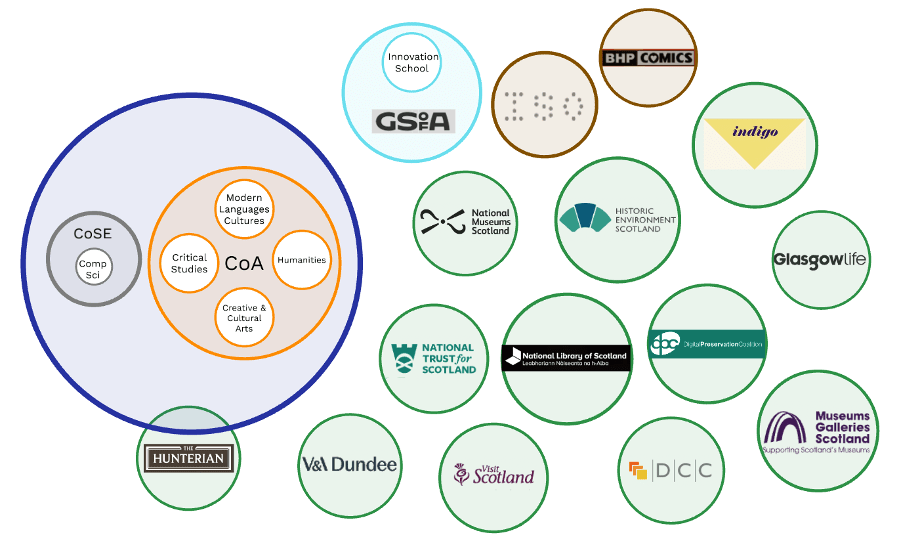

By piloting this approach to knowledge exchange, the Catalyst seeks to contribute to the on-going culture change in research, and enable researchers to engage with the world beyond the academy in a way that is equitable and sustainable. Adopting a design-led approach has allowed Catalyst networks to translate the challenges and opportunities identified by the process into tangible and genuinely co-created projects which fully account for the needs of all partners. Its development will continue to create exciting opportunities for impactful activity.
If you would like to know more about what we do, please get in touch!
 The Auditorium: a research culture and researcher development blog